The charismatic F1 and Le Mans driver Rupert Keegan has died at the age of 69. Andrew Marriott recalls a serious racer who also revelled in having "a great time"
Rupert Keegan was Kennedy's arch rival in British F1's peak season
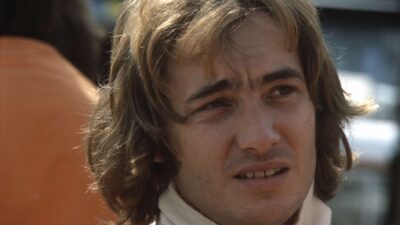
Rupert Keegan, who has died aged 69, after a long battle with cancer, was thought of as a playboy racer – some suggested more James Hunt than James himself. Certainly he was a rich kid and sponsors such as the top shelf magazine Penthouse and Durex added to the image but in truth he took his racing quite seriously. He won two major championships, started in 25 grands prix and had podium finishes in the world sports car championship.
Against his Twitter handle he wrote “connoisseur of life” and he certainly enjoyed it to the full – flamboyant, good looking and the son of a wealthy airline boss. In a trailer for his never completed film project called Made it Out Alive he said “I suppose I was a naughty boy but I was one of the guys who had a great time” while Emerson Fittipaldi added “If Rupert said there was a good party, you just had to go.”
Rupert Keegan was born on Feb 26, 1955 in Westcliff-on-Sea, the son of the pioneering airline boss Mike Keegan. Mike started on the shop floor as an apprentice at Vickers building Wellington Bombers in World War II and then served in the RAF as a flight engineer in Lancasters. When hostilities ended he set up his own cargo airline business to fly the Berlin airlift. This expanded into Britain’s largest cargo airline. Later he bought British Air Ferries and the so-called fun airline was emblazoned on the side of several of Rupert’s race cars.
F1 debut came with Hesketh – here Keegan races at the 1977 Austrian GP
Hoch Zwei/Corbis via Getty Images
Mike was hugely supportive of his sons Rupert and Rory. While Rory went on to found the famous London celebrity night spot Chinawhite, encouraged by his father Rupert was drawn towards racing and made his debut in an Escort Mexico in 1973 winning his first race. He quickly moved up to Formula Ford in 1974, was wild, crashed a lot but when he stayed on the track scored the odd win. This encouraged father Mike to buy the Hawke Formula Ford constructor from David Lazenby, and there was talk of building a BAF-Cosworth Formula 1 car to be designed by a young Adrian Reynard. It didn’t happen, but Reynard did design the unsuccessful Hawke DL18 F3 car raced just the once by Keegan.
In 1975 Rupert moved up to Formula 3 with an ex-Brian Henton March. It was definitely a learning year with plenty of accidents including a big shunt at Thruxton – but the experience was then put into good effect.
Picture it now: a Mercedes W10 gunning down the Brooklands straight at Thruxton, or Ferrari’s SF90 dicing with last year’s McLaren on the run up to Oulton Park’s Knickerbrook. British…
By
James Elson
For the following year, armed with the latest March 763, he was quick out of the box and spent most of the season battling for the BP Championship lead with factory March driver Bruno Giacomelli. With just a couple of points in hand he tangled with the Italian at the start in the final race at Thruxton and thus took the title. In the other F3 series sponsored by Shellsport, he finished second behind Giacomelli. By then he also competed in a couple of long distance sports car races in a 2-litre Lola and March.
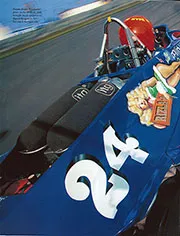
Although he then had a couple of F2 drives, his sights were now firmly set on Formula 1 before a plan for 1977 was hatched, which saw him join Hesketh Racing, now sadly in decline after James Hunt’s departure. With Guy Edwards’ help he pulled together sponsorship from Penthouse magazine and Rizla cigarette roll-up papers. The 308E design by Frank Dernie and Nigel Stroud was re-decked with the image of a Penthouse Pet laying down the side of the car clutching a pack of the roll up papers. At race meetings there were several Pets in their Memphis Belle-style French maid dresses on hand to cheer along Rupert. It started well: in his F1 debut at the Race of Champions, Keegan ran as high as fourth and memorably overtook Jackie Oliver’sShadow on the outside of paddock before eventually finishing eighth. His world championship rookie year was respectable, he qualified for all the races, had five top ten finishes but retired from the other half of the races after various incidents. The car he raced that year is the same one now taken to so much success in historic F1 races by Michael Lyons.
At the time Rupert was just 21 and it wasn’t all having fun. Later he said “All that Penthouse hype was good for the image but the playboy stuff was exaggerated, we wouldn’t party at race weekends, we’d go to bed early.” His chief mechanic at the time Dave “Beaky” Sims confirmed this, “James was really a party man, Rupert wasn’t like that – and he was fit”.
Surtees stint was difficult, as this blown engine at Kyalami demonstrates
Grand Prix Photo
For his second F1 season Rupert moved to Team Surtees, at the time still sponsored by Durex, further adding to Keegan’s hedonistic image. It proved a disaster, he only started in six of the 15 races and never finished inside the top ten. Thus for 1979 the decision was taken to drop down to the then-thriving Aurora AFX British Formula 1 Championship with an Arrows run by the Derbyshire-based Charles Clowes Racing team.
It proved to be a smart move and Keegan was one of the front-runners, starting the final round of the championship at Silverstone in third place behind David Kennedy in a Wolf and Emilio de Villota in a McLaren and with a slim chance of the title. The Spaniard spun and stalled in the race and the next lap Kennedy and Keegan, battling for second place, collided with the Irishman finishing up in the barriers. Keegan then had to finish in second which he duly did in a race won by the late Gordon Smiley. Thus he took the title by two points.
So for 1979 he moved back into the world championship as a privateer with a seven-race programme campaigning an outdated Williams FW07 run by John MacDonald of RAM Racing. His best result came at the end of the season when he placed ninth at the USCP at Watkins Glen.
He then took a year out a year out before embarking on season which combined racing a March 821 five races with several major sports car events and driving alongside Guy Edwards in the Ultramar Lola T610 3-litre machine. But results were poor in both campaigns.
The following season he tried his hand at IndyCar racing and took part in a handful of events with the Machinists Union March 85C-Cosworth. The following year with Gohr Racing he tried unsuccessfully to qualify for the Indy 500.
British F1 championship was won with Charles Clowes Racing in the Arrows A1 in 1979
Steve Powell/Getty Images
He then decided to concentrate on business interests in Miami but his crash helmet would occasionally pop up at events. In 1992 there were a couple of races in the Indy Lights series, in 1995 he returned unexpectedly to the Le Mans 24 Hours racing the mighty Lister-Jaguar Storm with Dominic Chappell and Geoff Lees. However they retired early with a broken gearbox. From 2013 he was an occasional competitor at both Goodwood’s Festival of Speed and the Revival, somewhat more portly but still bubbling with enthusiasm. At Goodwood he has raced everything from an Austin A35 to an Alfa Romeo P2 as well as a Ferrari 250GT and an MG Magnette.
Playboy racer he might have been, but Rupert Keegan did have talent and enthusiasm – he was great company, and can be considered an under-achiever.
Rupert died at the much loved family home at Elba in Italy. Motor Sport sends condolences to his daughter Sabrina and brother Rory.






 Great Read