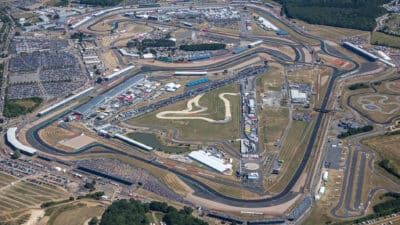
From wartime airfield to Formula 1 icon, Silverstone's evolution tells the story of how a series of British runways became a global motor sport landmark
Modern Silverstone layout has evolved from a Second World War airfield
Formula 1 continues its 75th anniversary celebrations this weekends, as it returns to the Silverstone circuit where the very first world championship race took place, and which remains its spiritual home.
Originally constructed as a Royal Air Force bomber base, RAF Silverstone, during World War II, the British circuit has evolved both in layout but also in identity over that period, remaining an integral part of the Formula 1 calendar.
Silverstone’s changes reflect the broader trends in motor sport: from makeshift, high-speed airfield races to a modern, technical, and safe circuit.
The airfield’s three runways, arranged in a classic WWII triangle, remain within the outline of the current track.
Silverstone is still a favourite among drivers for its high speed and flowing corners — especially the Maggotts-Becketts-Chapel complex – and is celebrated as the “Home of British Motor Racing.”
Silverstone in 1958
Getty Images
Construction and early years
Silverstone’s story began in 1943 when RAF Silverstone served as a base for Wellington bombers, its three runways laid out in the classic triangular pattern, as specified by the British Air Ministry in August 1942, which required three converging landing strips, each containing a concrete runway at 60-degree angles to each other.
When the war ended, Britain was in search of suitable venues to revive motor racing after the WWII hiatus, and the road around the airfield proved to be an ideal solution.
The RAC secured a lease from the Air Ministry and tasked ex-farmer James Wilson Brown with converting the airfield into a circuit in just two months.
The early track was rudimentary, with straw bales, oil drums and ropes defining the corners, and the X-shaped layout was distinctive, with a series of hairpins linking the runways, which meant that cars were racing towards each other, head-on at speed before braking hard and turning tightly away from each other before they met in the middle.
Silverstone’s 1948 configuration
The rethought layout in 1949
In 1948, the Royal Automobile Club staged the first official race at Silverstone — the RAC International Grand Prix — marking the start of its chapter as a motor sport facility and crowning Luigi Villoresi as the first Silverstone grand prix winner.
In 1949, the track unsurprisingly switched to using the perimeter roads, which brought a marked safety improvement, as well as a layout that remains the core of the modern circuit. A year later, Silverstone became a part of history, hosting the inaugural round of the Formula 1 World Championship, won by that year’s world champion. Giuseppe Farina.
Classic high-speed layout
By 1952, Silverstone settled into a permanent layout that followed the airfield’s perimeter roads. Legendary corners like Copse, Stowe, and the original Becketts demanded total focus, but the lack of run-off areas and barriers meant the venue remained dangerous.
Speeds had to be curbed in the 1970s
Grand Prix Photo
That year, the start line was moved to the straight between Woodcote and Copse, and while safety improved as the years went by, the basic layout of the track remained largely unchanged for nearly the next 40 years.
Alberto Ascari, Juan Manuel Fangio, Peter Collins, Jack Brabham and Jim Clark added their name to the circuit’s illustrious roll of winners during this early period when the British Grand Prix alternated between Silverstone and Aintree.
By the late 1960s and early ’70s, with rising speeds and driver safety increasingly in focus — thanks to 1969 and 1971 Silverstone winner Jackie Stewart — minor tweaks were made.
The most significant revision over that period was a chicane being added at Woodcote in 1975 in order to reduce speeds, as the car speeds were getting significantly higher, and the safety concerns kept growing.
The new chicane forced cars to slow down before entering the pit straight.
1975 modifications introduced a chicane at Woodcote
1991 brought major changes
Modernisation and major overhaul
By now, the British Grand Prix was alternating between Silverstone and Brands Hatch. And as turbocharged engines and better aerodynamics made F1 cars even faster, Silverstone saw its first significant changes in the 1980s.
Silverstone underwent major changes in 1991
Grand Prix Photo
A chicane was added to Abbey in 1987, and the track was resurfaced and modified to improve safety. The Luffield corner was added, and the Bridge chicane was also introduced, all in time to see Nigel Mansell charge down Nelson Piquet’s 30sec lead and make an audacious passing move to win.
That year also marked the start of Silverstone’s exclusive hold on the British Grand Prix: it has only been held at the circuit since then.
Mansell-mania in 1991 coincided with a major overhaul, with the changes being some of the most significant in its history.
In response to both safety concerns and the need for a more technical, TV-friendly layout, Silverstone underwent a radical transformation.
Silverstone is unrecognisable as the circuit that hosted the first F1 Championship race but still retains its old glory, writes Damien Smith. If only there had been a way to keep Bridge Corner
By
Damien Smith
The Maggotts, Becketts, and Chapel corners were reconfigured into a fast and complex left-right-left-right-left sequence, making this section one of the most demanding on the calendar.
The radius of the Copse corner was increased to alter its approach and exit speeds.
The Vale complex was introduced between Stowe and Club corners to create a new overtaking opportunity and slow the approach to Club.
A new infield section was added after Abbey, replacing the old Farm Straight and Bridge chicane.
The revisions took the circuit length from 4.778km to 5.226km and transformed it from a high-speed layout into a much more technical and challenging track.
Incremental changes
After the 1991 overhaul, many smaller changes were made over the following decade.
Silverstone came under threat in 2009
Grand Prix Photo
Between 1994 and 1997, corners were reprofiled and run-off areas expanded for safety reasons. The Bridge section remained in use, the Abbey chicane was tweaked, and new facilities improved the spectator experience.
By the late 1990s, further modifications were made to restore speed and flow, especially at Copse, Priory, Brooklands, and Luffield.
However, a decade later, Silverstone’s ageing infrastructure became a sticking point and the race was under threat as F1 supremo Bernie Ecclestone demanded higher race-hosting fees and a long-term commercial agreement to match those imposed on other venues.
The British Racing Drivers’ Club (BRDC), which owns Silverstone, was initially unwilling to meet Ecclestone’s financial demands or agree to the proposed contract length, and the British GP looked set to move to Donington Park from 2010.
Donington, however, failed to secure the necessary funding for required upgrades, and eventually the standoff came to an end, with Silverstone retaining the race but having to commit to a major redevelopment.
The Arena era
The result of Silverstone’s new agreement with F1 was the 2010 debut of the Arena layout — a new infield section extending from Abbey through Farm, Village, The Loop and Aintree, before rejoining at Brooklands.
The Wing was a major development for the circuit
Grand Prix Photo
This layout extended the circuit’s length once more, to 5.89km. It also improved overtaking opportunities, especially at Village and Brooklands.
Perhaps more importantly, it facilitated the construction of the Wing complex, the new pit and paddock facility on the International Straight (now Hamilton Straight).
Since 2011, the Arena layout has been the home of the British Grand Prix.
Some minimal tweaks have been made since then as the track remains one of the fastest and most revered in the world.
Technical details
Specification
Value
Full Circuit Length
5.891 km (3.66 miles)
Number of Turns
18
Main Straight Length
770 meters
Fastest Race Lap
1:27.097 (Max Verstappen, 2020)
F1 race winners
Related article
The British Racing Drivers’ Club (BRDC), which owns Silverstone, was initially unwilling to meet Ecclestone’s financial demands or agree to the proposed contract length, and the British GP looked set to move to Donington Park from 2010.
Donington, however, failed to secure the necessary funding for required upgrades, and eventually the standoff came to an end, with Silverstone retaining the race but having to commit to a major redevelopment.
The Arena era
The result of Silverstone’s new agreement with F1 was the 2010 debut of the Arena layout — a new infield section extending from Abbey through Farm, Village, The Loop and Aintree, before rejoining at Brooklands.
The Wing was a major development for the circuit
Grand Prix Photo
This layout extended the circuit’s length once more, to 5.89km. It also improved overtaking opportunities, especially at Village and Brooklands.
Perhaps more importantly, it facilitated the construction of the Wing complex, the new pit and paddock facility on the International Straight (now Hamilton Straight).
Since 2011, the Arena layout has been the home of the British Grand Prix.
Some minimal tweaks have been made since then as the track remains one of the fastest and most revered in the world.
Pablo has been covering motorsport (mainly F1 and MotoGP) as an editor and writer for over 20 years, having worked for Autosport and Motorsport.com before joining Motor Sport Magazine.