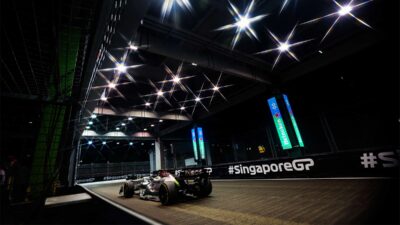
Due to city construction, the beloved grandstand chicane has been removed from this year's Singapore GP layout. But, as Chris Medland writes, could this help drivers and their cars during the toughest race weekend of the season?
The beloved grandstand chicane: wiped from Singapore in 2023
15 years of the Singapore Grand Prix, and for at least 14 of them the build-up to the event has featured a heavy focus on the unique challenges it provides.
At first it was the only night race on the calendar, and so the unusual timezone was regularly cited as something that teams and drivers had to deal with. So too was the immense physical test that was the result of the humidity and race length. Although it has some straights that are relatively long, the right-angle corners (or even tighter) and sheer number of turns meant the average speed has always been low in Formula 1 terms.
Watch F1 via live stream or on TV: dates and times for the 2023 Singapore Grand Prix from Marina Bay, including qualifying and the grand prix
By
Cambridge Kisby
And a low average speed means it takes a lot longer to complete the race distance, so it was not uncommon to see the two-hour time limit coming into play, or races at least getting within ten minutes of it and being the longest of the season whether there were interruptions or not.
In fact, the temperatures and humidity aside, interruptions were sometimes welcomed by the drivers who could get a form of breather that they otherwise wouldn’t be able to enjoy. If enjoy is the right word when you’re still sweating out up to four kilograms of your body weight.
But as Bob Dylan once wrote, the times they are a changin’, and as stunning as Singapore is visually, it is no longer the only night race on the calendar. Far from it.
Bahrain, Jeddah, Qatar, Las Vegas and Abu Dhabi all feature at least spells of racing under floodlights, and while four of those spectacles have been seen already in previous seasons, it could well be that Vegas takes the mantle of the most iconic backdrop to a night time grand prix when it joins the party in two months’ time.
Cars will race past the Ballagio fountains on the Strip in Las Vegas this November
Tilke Design and Architects
Those are developments or additions that are largely out of Singapore’s hands, aside from the fact the race organisers must have now agreed to a contract that does not specify that it must be the only night-time event in F1. But there’s one change that will impact this weekend’s race that could well prove significant in the way it affects the whole character of the grand prix, so needs to be analysed closely when plans for the future are considered.
Construction work on a new community and events venue where the floating stadium used to be means the track cannot run in front of (and under) the grandstand that used to make up the Turn 16-19 complex in the final sector.
Granted, that’s an unavoidable situation if you want to develop that part of the city, and it should only be a temporary change that might even be reversed as early as 2024 – although the overall project is likely to take until 2026 to complete – but the impact on the track layout could be notable this year.
Removing four low-speed corners doesn’t sound like much in isolation, but it has knock-on effects.
For starters, the lap time is going to be reduced by up to eight seconds in qualifying trim because drivers will now be flat out from exiting Turn 14 to braking for what was previously Turn 20 but is now Turn 16. A quicker lap time means the race itself is going to be shorter in terms of the clock (safety car deployments and red flags permitting), and easier to handle physically as drivers became far less likely to have to maintain an intense level of performance for close to the full two hours.
“I think it’s interesting,” Kevin Magnussen says. “It’s probably going to make it slightly less demanding physically, it’s going to be faster, so it’s probably going to last for a shorter time so we’ll lose less liquid.”
It also becomes easier to handle for the drivers simply for there being four fewer corners to subject them to G-forces under braking and turning.
Drivers have suffered under the intense heat and humidity of Singapore in the past
Getty Images
And it’s not just about the drivers, either…
“That will change the nature of that circuit quite a lot,” Dave Robson, head of vehicle performance at Williams, says. “Not so much in terms of the downforce level I don’t think, but in terms of braking is always difficult there.
“The energy the brakes have to deal with, the rear tyre degradation is always really difficult by the time you get to the last sector. So to have those corners taken away from that part of the circuit I think does change the characteristic of the circuit quite a lot, for everyone obviously.”
Myles Rowe made history when he became the first ever African-American to win a single-seater championship, garnering adulation the world over
By
James Elson
It’s still going to be far from an easy weekend for both driver and machine, but the challenge will be diluted somewhat from what it has been in the past.
Where Singapore has to hope there’s a further characteristic change is when it comes to wheel-to-wheel racing. The longer straight and bigger braking zone into Turn 16 could open up passing opportunities, or potentially allow cars to follow more closely into the final part of the lap. That might facilitate moves into Turn 1, where there was already a fair bit of action last year.
Should that prove to be the case then it might actually leave Singapore with a decision to make. Does it want a track layout that provides better racing but less of a physical challenge, or does it want to remain as the ultimate test of the drivers’ fitness?
If construction work goes well, this weekend’s race will be the only sample set the organisers get to try and understand the impact of a different track configuration on the overall event. There are unlikely to be many complaints if an epic grand prix leads to a consideration to stick with the faster layout, but it could be that one of the aspects that made the Marina Bay Street Circuit stand out from the rest is lost from this weekend onwards, all thanks to the removal of four relatively nondescript corners.
Going freelance in 2015, he's now RACER's F1 correspondent, works with Formula 1's channels as well as SiriusXM's broadcast coverage in the US, and made far too many appearances in the first season of the Netflix F1 documentary.