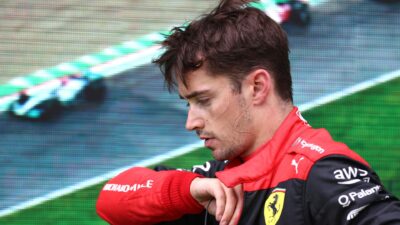
Points gone begging, crucial opportunities missed and a championship slipping away – it’s been the story of Charles Leclerc’s and Ferrari’s season.
In the F1-75, the Scuderia arguably has the best car this year and there’s strong reason to believe the Monégasque is F1’s fastest driver, but the results haven’t been reflective of that combined speed.
Leclerc has claimed seven poles, but converted only three into wins this season. Another startling statistic is that Leclerc, a veteran in his fifth season, has five career wins – his title rival Max Verstappen has claimed seven this year alone.
It could have all been so different though – the Ferrari driver has thrown his car off the road from strong positions, and this has been exacerbated by poor reliability, combined with indecisive calls from the pit wall.
Red Bull and Verstappen too have had errors of course. Verstappen suffered two early-season breakdowns from strong positions, and the Dutchman spun off in Spain, but he fought back to win – with the help of his team moving Sergio Perez out of his path.
The reality is, if both competitors had maximised the positions available to them on pure performance, Leclerc would still be some way ahead in both title races.
Therefore, it’s his lost points that are likely to influence this year’s championship fight. Below, we examine the key moments that may have lost driver and the F1 crown, and how the championship’s complexion would look if they hadn’t.
Leclerc entered the fourth race of the F1 season saw in a strong position having won Bahrain and Australia and finished second to Verstappen in Saudi.
Though things in Imola didn’t go quite as well to begin with, losing the sprint to Verstappen then conceding second to Sergio Perez at the start of the GP, the Ferrari man still looked on for a solid podium and with it 15 points.
Leclerc wanted more though, and put his foot down in pursuit of the second Red Bull, which was ultimately to be his undoing.
Leclerc’s error cost him a podium place in front of Ferrari’s home crowd
Dan Mullan/Getty Images
On lap 54, he bit off more than he could chew at the Variante Alta, bouncing over the kerbs and spinning before settling into the tyre barrier.
Though he was able to continue and pitstop was required to change his front wing – he ultimately came home sixth, and what would have been 15 solid points in the bag became eight.
Leclerc would have finished the weekend at on 93 points, with the Red Bull boys still in 50s. As it was, he still had a 37-point margin on Verstappen post-Imola, but it was sign of things to come.
Leclerc had lost out on the win to Verstappen in Miami, but an assured second place meant his and Ferrari’s title destinies were still in their hands at this point.
The Scuderia’s championship leader had put his F1-75 on pole by 0.3sec from his title rival, confidently converting this into first place into Turn 1.
Things got even better when a gust of wind sent Verstappen spinning off at Turn 4, before he then had to contend with DRS issues after rejoining in fourth place.
At this point the GP belonged to Leclerc. Despite making a pitstop, he still had a 14sec margin on George Russell – then it all went wrong.
An engine failure put him out of the race on lap 27 and denied what looked to be an easy win. Not only this, but the penalty from cumulative PU changes would also come back to bite him later.
It was at this point that alarm bells were stating to ring for Leclerc – this was the first time he had ceded the championship lead to Verstappen.
Another ‘easy’ win for Leclerc which went begging. The Monegasque was desperate to win his home race, and it looked like it just might happen this year.
The local hero again took pole by almost 0.25sec on the narrow confines of the principality.
Though the race was rain-delayed by over an hour come Sunday, once it did get underway it was the Leclerc who led from a rolling start.
The Charles Leclerc Monaco curse continues, but the Monégasque at least finally has a finish to his name in his home race. After beautiful weather all weekend, rain had been…
By
Chris Medland
On a circuit which is difficult to overtake at the best of times, the Monegasque calmly extended his advantage, which was up to almost 5sec from team-mate Carlos Sainz.
However, once the track began to dry out and a switch to intermediate tyres became an option, it all started to fall apart for Ferrari.
Leclerc and his team decided to switch compound on lap 19 – but it was already too late: Sergio Perez had done so two laps earlier, and the Ferrari emerged from its stop almost two seconds behind.
The win looked to be gone, but a podium was still on – but for another Scuderia error three laps later. A confused pit message meant Ferrari inadvertently double-stacked its cars, with Leclerc coming in for slicks just behind Sainz.
The tyres weren’t ready, and the Monegasque was dropped to fourth, where he finished. Leclerc described the race at the end as a “freaking disaster”.
He’s not wrong – further ground had been lost to Verstappen on a day which should have been Leclerc’s.
Yet another pole for Leclerc, but this time he lost out at the start. The Ferrari driver got a worse launch than Perez off the line, then locked up into Turn 1 meaning the Mexican got past up the inside with ease.
When team-mate Sainz ominously broke down with an engine failure Ferrari decided to pit its other driver on lap 10 and fitted him with a set of hard tyres, looking to possibly go all the way to the end.
A slow stop for Perez then meant that Leclerc was in the lead – could he make the one-stop work for the win? We’d never find out.
His engine blew too on lap 20. Verstappen cruised home to take full points after overtaking Perez, leaving a distraught Leclerc speechless in the aftermath.
The championship gap to Verstappen was now looking ominous, with Ferrari’s lead driver now more than a win’s worth of points behind.
Leclerc managed to fight back through the field in Montreal, but could have had more
Ferrari
The Barcelona and Baku blowouts meant that Leclerc would take grid penalties for Montreal, starting from the back.
Leclerc gradually climbed his way through the field until he was seventh by lap 21 and encountered his first real issue – Esteban Ocon.
The Alpine driver was able to exploit his superior traction out of the corners combined with straight-line speed to stay ahead of the Ferrari, with Leclerc expressing his frustration at being bottled up.
He would eventually get past to finish fifth, but it was another weekend of what might have been.
His team-mate Sainz managed to exploit a late virtual safety car to take on fresh tyres and pressure Verstappen for the win late on. With Leclerc appearing to have had a clear pace advantage on his team-mate all year, it’s quite possible to hypothesise that the Monegasque would have got the job done and won, had he not had to start from the back.
Instead he lost more points to Verstappen, the gap now at almost two wins.
Leclerc found himself starting third on the grid after a spin in a wet qualifying at Silverstone, but this would be another victory seemingly lost from a winning position – again from questionable Ferrari strategy calls.
After a red-flagged initial start due to Zhou Guanyu’s huge crash, on the second time of asking Leclerc managed to dive bomb Perez into The Loop for third, damaging his front wing as they connected but not appearing to lose any speed.
The Monegasque was then permitted to overtake his team-mate Sainz for second later on, after the Spaniard had gone off, lost the lead to Verstappen and didn’t look like showing the pace to take it back.
Sometimes a grand prix throws up such a shocking moment it’s going to overshadow everything, but it’s a testament to the quality of the race that followed that this year’s…
By
Chris Medland
The Red Bull driver then pitted after running over debris, meaning the race lead had come to Leclerc, who looked potentially the fastest man on track anyway.
Once more though the racing wind changed direction, and Ferrari reacted in a way which appeared unfavourable both to its drivers’ and constructors’ campaigns.
Esteban Ocon stopped on the pit straight, bringing out the safety car and the chance of a cheap stop.
Sainz and Hamilton (who had been running third, fourth and fifth) came in, leaving Leclerc out on his 14-lap old hard tyres, at the mercy of those on new soft tyres behind him.
Leclerc went off when defending from Sainz, before losing out to the Mercedes and Red Bull too.
Could he have won by pitting for fresh tyres under the safety car? It looked likely, but Ferrari reasoned Hamilton would have stayed out and Leclerc would have lost track position anyway to a car whose laps were only four laps older than the Scuderia car, struggling to get by.
Leclerc was left a disgruntled fourth which earned him 12 points, with another 25-point win potentially dropped.
As a wounded Verstappen finished seventh, this would have been high-time to capitalise in the championship, but once more Ferrari missed out.
Despite the season turning into something of a nightmare, Ferrari and Leclerc still believed the campaign could be salvaged. A dominant win in Austria two weeks earlier gave hope, but another engine failure for Sainz in the same race was a reminder of the multitude of problems Ferrari has given itself this season.
The Spaniard’s resulting grid penalty in France meant the team decided to use him to give Leclerc a tow in qualifying and it worked, the latter securing pole by 0.3sec.
Come race day, he converted this into the lead, though looked under pressure from the slippery Verstappen on the Mistral Straight. The Red Bull then looked to be hurting his tyres, and Leclerc began to pull away – so far, so good, but then…
Leclerc, pushing to the limit as always, lost the rear of his F1-75 through the demanding high-speed Beausset, spinning off into the barriers.
He was out of the race, and had sacrificed another win’s worth of points to Verstappen.
Now suffering a 63-point deficit to his title rival, things are looking tough for Leclerc. Roughly equal to just to 2.5 wins, the gap with ten races left doesn’t seem insurmountable at first glance.
However, with a regular pattern of driver error, mechanical issues and poor strategy calls already bedded in at Ferrari, there appears more chance of Verstappen extending his championship lead rather than being susceptible to a Leclerc fightback.
Ferrari fits the hard tyres in Hungary, even though Alpine pace should have sounded the alarm
Peter J Fox/Getty Images
It seems hard to believe, but the Hungaroring represented yet another race where Leclerc and his team should have fairly easily maximised points, but instead threw them out the window through poor strategy.
Leclerc had held his up his end of the bargain and by lap 31 had overtaken George Russell and was in control of the race.
Happily running in first, the Monegasque told his the team that his medium tyres felt fine. Then on lap 38 Verstappen pitted, and Ferrari was frightened into reacting against an apparent small threat of an undercut from the Red Bull driver.
Most drivers have been very complimentary to how the new F1 cars allow drivers to battle – but say DRS is still necessary
By
Adam Cooper
To compound the situation, the Scuderia made an explicable tyre change decision. On a cool day in Hungary, both Mercedes and Red Bull had worked that the hard compound was not one to use the race day, correctly deducing that it would offer no grip.
As a result all four of those respective teams’ drivers ran two stints on medium tyres and one on softs in varying orders.
Ferrari though inexplicably decided to strap on the hard tyres for the final stint anyway, even with Alpine clearly demonstrating in the race with both its cars that the hard tyre compound had no grip, as Fernando Alonso and Esteban Ocon similarly struggled.
“These tyres are ****,” Leclerc said pithily, defenceless against attacks from Verstappen, Russell, Sainz and Hamilton as the Scuderia’s chances now lay dead in the water.
In the end Ferrari pitted Leclerc again for softs anyway, as he ultimately finished an impotent sixth.