“We used to say ‘How the hell do you know when to go with the qualifying tyres?’” he recalls. “‘How do you know whether you’ve got the fronts and the rears in and that they’re going to last you to the end of the lap?’
“Ayrton said ‘It’s like tying a tie. Sometimes you get the tail too long, sometimes you get the tail just right. If you get it right, that’s how you manage the tyres.”
“He brought that ability to the table. That set him apart from the other drivers. I’m not saying the other drivers didn’t know how to bring the tyres in, because they obviously did. But he was so good at maximizing everything, all the variables, to get the absolute best. He was phenomenal.”
The Brazilian still had it all to do come Sunday though. Dark clouds gathered at midday and by the race start Estoril was experiencing monsoon conditions. A Lotus team that hadn’t won a race for three years weren’t overly confident.
“We were so not confident!” Hallams remembers. “Not that we doubted the driver’s ability, but in those conditions, it really is down to them. There’s just the classic (wet weather set-up) brake-bias two turns to the rear and ‘Good luck chap!’”
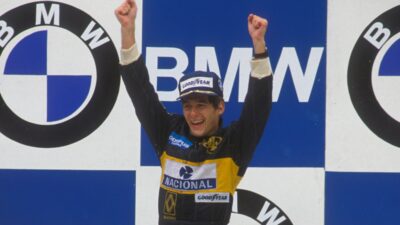
Senna didn’t appear particularly fazed – this was his moment. As the lights went out, the Hethel new boy rolled away calmly to convert pole into the race lead. De Angelis meanwhile jumped from fourth to second, providing a handy 97T-shaped buffer between the leader and the rest of the field.
Subsequently, Senna simply drove off into the distance, making the extremely difficult appear a breeze. By lap 10, he’d pulled out almost 13sec on his team-mate.
What was key to his advantage in the wet?
“There was the recognition that ‘Oh my god, this guy is truly special, this isn’t just a one-off’”
“Those cars have a lot of power, they were really quite crude compared to Formula 1 cars decades later. Those drivers really did have to manage throttle usage and their gear selection.” says Hallam.
“I mean that in two respects. One is that it was an H pattern shift. But also just coping with the low grip conditions from a wet race. Ayrton said ‘Well, doesn’t everybody run a gear taller in these conditions?’ I’m not sure everybody did, but he was doing so in an effort to maximize the usage of the car for the prevailing conditions.”
Senna’s instinctual feeling for the rubber he had on the road also came into play.
“It comes back a little bit to the explanation about the qualifying tyres.” Hallam tells us, “The drivers that were good at feeling the tyres and knowing how to manage tyres were also good at managing the wet tyres.