


Awards
Season Review Awards: 2022’s greatest F1 moments chosen by you
The best moments of the 2022 F1 season as voted by you

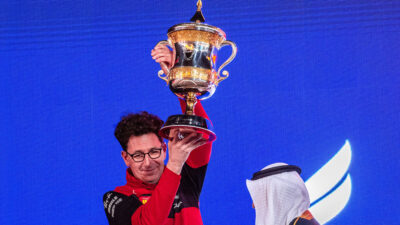
Binotto raises the winning constructor trophy in Bahrain. The season ended very differently
Ferrari
Twelve months ago, if I’d said to you that Mattia Binotto would be leaving the role of Ferrari team principal at the end of 2022, I doubt you’d have been massively surprised.
If I’d told you that same information less than eight months ago after Charles Leclerc had won the Australian Grand Prix, I reckon the opposite would have been true.
At that point Leclerc had a 46-point advantage over Max Verstappen in the drivers’ championship. The Red Bull was overweight and unreliable, while the Ferrari could claim to be neither of those things. How quickly things can change.
23% of Leclerc’s total points this season came in those first three races. It really was the high point for Ferrari and all started to unravel fairly quickly through Leclerc’s own mistakes (Imola, France), Ferrari’s lack of reliability (Spain, Azerbaijan) and strategic errors (Monaco, Silverstone, Hungary).

“I’m losing too many points,” Charles Leclerc admitted after crashing out at Paul Ricard
Marc de Mattia / DPPI
But what that list shows is there wasn’t just one weakness for the team to address, there were multiple areas in which it needed to clean up its act. And should that really come as such a surprise?
Ferrari finished sixth in the constructors’ championship in 2020. It was a horror year after being hit by FIA clampdowns on power units, and the catalyst for a major change in personnel as Binotto made the brave decision to drop Sebastian Vettel and bring in Carlos Sainz.
The best moments of the 2022 F1 season as voted by you
It marked a new Ferrari, one that was building for the future. Sainz was clearly delivering excellent results and performances for McLaren — a team trying to rebuild, with a tricky car to drive and one that Sainz would help Ferrari beat in 2021 — but to replace Vettel showed huge faith in Leclerc alongside an admission that it might take time to get back to winning ways.
That was true a year ago, but the drivers delivered with third overall, and then the spectacular start to 2022 happened. Ferrari had looked good all pre-season, but in some ways never like the benchmark. It was just right in the mix at the front, unlike the previous two years, and that represented a clear step forward.
The brilliant first three races from Leclerc’s point of view then raised expectations to a level nobody could control, or match.
Ferrari’s not far away, and that’s what makes the failures so frustrating
There’s a journalist in the F1 media centre who regularly gets some stick – including from myself – for arguing some strange stances such as that he’d rather finish third than second because second is so close to first, but third is just happy to get a trophy (or a medal when he tries to justify it with Olympic podiums).
Another one of his theories is that unless you win the title it’s better to not have a great year as a rookie in Formula 2 as your stock rises so far that it’s almost impossible to avoid it dropping in the second season. But if we apply that to Ferrari, he may have a point.

Early 2022 wins were greeted by euphoria — and raised expectations
Ferrari
If Ferrari’s season was run in reverse — it had started with a car that was closest to Red Bull but not quite there, and finished it with two wins and a second place despite the championship still being long-since won by Max Verstappen — it would be looked upon far more positively.
Even without that hypothetical situation, it probably deserves a bit more credit for the massive step forward it made after two tough years, even if it was preparing to take advantage of the new regulations.

Mattia Binotto has carried the can for Ferrari’s 2022 failings by resigning as F1 team principal. But a new boss won’t solve the team’s fundamental problem which has dogged it for more than a decade, says Mark Hughes in our season review podcast
The hardest part is delivering a car capable of winning races. And that’s what makes this year so tough to truly judge in the context of Binotto’s departure.
He could pretty much tick off the most difficult aspect of the job. But then areas that should have been easier to tackle were severely lacking, particularly in the way the team operated during a race weekend.
The final two races showed that up perfectly, with Leclerc being the only car on inters at the start of Q3 in Brazil seeing Ferrari come under scrutiny. It was very nearly a genius call, but the risk was one the team probably didn’t need to take given where he ultimately ended up qualifying. That was followed by excellent strategy in Abu Dhabi to beat Sergio Perez to second overall, though, and end the season on a higher note.

An uplift in Abu Dhabi saw Leclerc secure second place in the drivers’ championship
Ferrari’s not far away, and that’s what makes the failures so frustrating. But it also makes Binotto’s departure far from clear cut as the right or wrong decision.
As much as it has been positioned as a resignation, Binotto was clearly handed the pen and shown where to sign, especially after Ferrari put out a statement two weeks ago that the reports he would be leaving were “totally without foundation”.
The support from above was no longer there, and perhaps doubts had crept in among the drivers – particularly Leclerc – too. But the improvements in competitiveness could have acted as a safety net that bought Binotto more time to show he could deliver similar strides in other areas of the team.
Instead, the decision has been taken to entrust that to someone else. It may well be Fred Vasseur who gets handed the reins, but Alfa Romeo hasn’t been perfect at all times either, and regardless of who finally gets the job they’ll need time to make improvements.


22 races, 20 drivers and 10 teams — our experts look back over a dramatic 2022 Formula 1 season
It’s not football, where a key weakness can be addressed quickly in a transfer window by signing players (if you have the funds). Even going out and poaching the best from other teams in areas that Ferrari clearly needs to improve — such as strategy — will then involve lengthy periods of gardening leave. And they will still only be judged on whether the car is competitive. That’s a car and power unit that has been developed under Binotto’s leadership, don’t forget.
Once he rose to the position of team principal, Binotto was always going to be less involved in regular technical work, just like he doesn’t make the strategic calls or deliver power unit reliability. He takes responsibility for all of those, but removing him doesn’t lead to a step-change in the day-to-day, just as a new arrival won’t.
If Ferrari is winning races again in 2023 then it will have been put into a consistently strong position by the work done over the past three years. If not, then perhaps it will have been vindicated in instigating the change, but neither is a total success now either way.
Where Ferrari is next season will not be a reflection on the new team principal, but it will be on Binotto and the decision to push him to the door. And only then can we really judge if it was the right move.