With Marlboro bringing down the curtain on its title sponsorship of Ferrari, in our latest edition Mark Hughes charts the cigarette brand's 50 years of F1 involvement
Marlboro: synonymous with F1 after a 50-year association
Now more than ever, Formula 1 is focused on portraying itself as progressive and green – technology-driven and aiming to do its bit to help the world.
As Mark Hughes writes in the latest edition of Motor Sport though, it wasn’t always like this – our grand prix editor has charted the course of Phillip Morris’s hugely lucrative and successful involvement in Formula 1, via its then-world No1 brand Marlboro. Scroll down to view our ‘Marlboro in Formula 1: Through the ages’ gallery.
With Phillip Morris’ title sponsorship of Ferrari finally ending in 2022, it brings to a close the intertwined 50-year journey of F1 and Marlboro – for now.
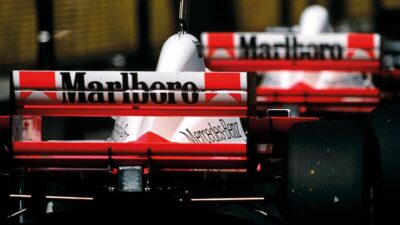
It was a period when giants walked the earth, F1 legends were made and grand prix cars often really did represent cigarette cartons on four wheels. Motor racing purportedly represented a hedonistic and carefree world powered by individualism, with Marlboro intending to bask in this glorious image.
The cigarette manufacturer’s premier brand first entered motor racing’s top-tier with BRM in 1972, the company announcing itself with a typically understated PR stunt of an F1 car exploding out of a gigantic Marlboro packet.
Entry into grand prix racing came with BRM
GP Library/Universal Images Group via Getty Images
“We could see that advertising was coming to an end and we needed [another way] to make ourselves visible,” said John Hogan, the Marlboro marketing man who brought the brand into grand prix racing. “F1 was a way of doing that on the international stage. We were trying to do it before the black curtain came down.”
Two years later and the brand leapt ship to McLaren, forming one of the most iconic team and sponsor combinations in sporting history. Though Emerson Fittipaldi was the first driver to take a title in the brand’s colours – the company funding his move from Lotus – it was James Hunt who would first become ingrained in the public’s consciousness as a champion driver decked out in particular shades of red and white.
Gallery
Marlboro in F1: Through the ages
Marlboro replaced perfume brand Yardley at BRM
AFP via Getty Images
Peter Gethin prepares to head out for BRM at Brands Hatch ’72
Fittipaldi’s move to McLaren was facilitated by Marlboro money, and brought instant success
Grand Prix Photo
Marlboro-branded McLaren mechanics work on Denny Hulme’s car at ’74 Canadian GP
DPPI
Gilles Villeneuve’s F1 debut came in McLaren-Marlboro colours at Silverstone ’77
Bernard Cahier/Getty Images
Marlboro sponsored numerous other teams – here is Bruno Giacomelli in red and white for Alfa Romeo in ’81
Grand Prix Photo/Getty Images
Mika Häkkinen was a Marlboro junior driver, rising through through the ranks to eventually drive for Macca
Jean-Yves Ruszniewski/TempSport/Corbis/VCG via Getty Images
Similar to Fittipaldi almost 20 years earlier, Phillip Morris cash made Schumacher to Ferrari possible
Georges MERILLON/Gamma-Rapho via Getty Images
Marlboro eventually became title sponsor of Ferrari in from ’97 – Schumacher dons the colours at Budapest ’98 above
PIERRE VERDY/AFP via Getty Images
Schumacher and co became forever associated with the colours of Marlboro after their supreme F1 success
Clive Rose/Getty Images
PMI’s last brand to feature on Scuderia cars was its ‘Misson WInnow’ initiative
Xavier Bonilla/NurPhoto via Getty Images
The world’s fastest forty-a-day smoker – often seen post-race with a cigarette in one hand, beer in the other and glamorous female by his side – was exactly what Marlboro strove to embody: the freewheeling thrill-chaser who knew what he wanted.
However, as Hughes highlights, Marlboro would soon become associated with a McLaren team completely transformed after its takeover by Ron Dennis.
“Dennis-era McLaren in the 1980s, with its cutting-edge carbon fibre cars, […] were piloted to world titles by Niki Lauda, Alain Prost and Ayrton Senna.
“Hogan, who worked hand-in-glove with Dennis, was the crucial early benefactor. It was an evocative image – the Marlboro orange-red shimmering out of the heat haze, first past the chequer again and again. And like that, Dennis built an F1 team which redefined the scale, leaving the rest spluttering to keep up, with Dennis leaving Hogey spluttering each year as he ramped up the required sum for his next conquest.”
After McLaren’s winning of F1’s riches, it was Ferrari’s turn to be seduced. The Scuderia had entertained Marlboro as a sponsor since 1984, but when the latter finally split from McLaren and became Ferrari title-sponsor in ’97, forevermore would its colours be associated with the Schumacher-Todt–Brawn axis which brought five consecutive title doubles between ’00 and ’04.
James Hunt embodied the freewheeling, charismatic image Marlboro was seeking
Bernard Cahier/Getty Images
Hughes illustrates the influence of Marlboro at the Italian team:
“So vast were its resources it would come to effectively supplant Fiat as the race team’s parent. The Scuderia Ferrari Marlboro’s management often recruited personnel from Philip Morris’s base and worked in conjunction with the company’s management.
“So strong was the visual association of the Marlboro insignia that it almost didn’t matter when tobacco advertising was banned from the cars in Europe in 2010. Strategic use of the Marlboro chevron and later of a barcode on the engine cover made the visual reference obvious without spelling out any name.”
It couldn’t last forever though, and after the slightly botched Mission Winnow branding of the last few years – there to market PMI’s smoke-free products apparently designed to initiate “positive change in society” – it has now been announced that the company will no longer be Ferrari’s title sponsor. Up the grid, then up in smoke.
Read Mark Hughes’ full article in our new issue here.





 Great Read


