


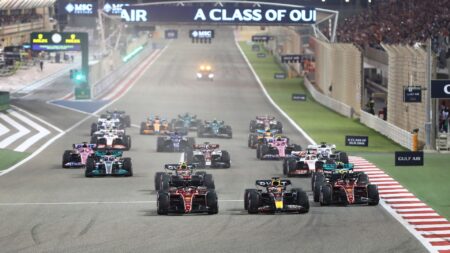
F1
Autolinking test 3: What's new in Formula 1 2023: drivers, team bosses and rules
All the refreshed driver pairings, team principal changes, and subtle regulation tweaks that could shake up the 2023 F1 season

Sebastian Vettel holds off polesitter Lewis Hamilton for victory in Australia

Ferrari’s Sebastian Vettel won the Formula 1 Australian Grand Prix at Melbourne after a mid-race virtual safety car dashed Lewis Hamilton’s chances for victory.
Vettel pitted during a VSC session (which turned into a safety car) triggered by both Haas cars leaving the pits with loose wheels, a faulty wheelgun to blame, after Hamilton and Ferrari counterpart Kimi Räikkönen had pitted just laps earlier. Hamilton kept on Vettel’s tail for 26 laps but could not catch up, even with the third DRS zone added to Albert Park. The defending champion ended up five seconds back from the leader. The bizarre series of events denied the Haas pair a double-points finish, as Kevin Magnussen and Romain Grosjean were running in fourth and fifth respectively.
Home favourite Daniel Ricciardo recovered from a three-place grid penalty to finish fourth behind Kimi Räikkönen. It was an attacking Fernando Alonso who took fifth after pitting under VSC, his joint-best finish for McLaren, and he praised the Renault power unit after the race.
Max Verstappen, jumped at the start by Magnussen, spun on lap 10 and had to recover from eighth to sixth on overheating rear soft tyres. Nico Hülkenberg finished seventh, ahead of Mercedes’ Valtteri Bottas who recovered to eighth from 15th on the grid due to a crash in qualifying.
Carlos Sainz Jr rounded out the top 10 while Force India missed out on a points finish with Sergio Pérez 11th and Esteban Ocon in 12th. Charles Leclerc passed Lance Stroll for 13th, with Toro Rosso’s Brendon Hartley the last finisher in 15th. Sergey Sirotkin (brakes), Pierre Gasly, and Marcus Ericsson were the remaining retirees.
For full analysis of the race, sign up for the Mark Hughes newsletter to receive the in-depth Grand Prix report following the Grand Prix.
| 1 | Sebastian Vettel | Ferrari | Lap 58 |
| 2 | Lewis Hamilton | Mercedes | +5.036sec |
| 3 | Kimi Räikkönen | Ferrari | +6.309sec |
| 4 | Daniel Ricciardo | Red Bull | +7.069sec |
| 5 | Fernando Alonso | McLaren | +27.886sec |
| 6 | Max Verstappen | Red Bull | +28.945sec |
| 7 | Nico Hulkenberg | Renault | +32.671sec |
| 8 | Valtteri Bottas | Mercedes | +32.671sec |
| 9 | Stoffel Vandoorne | McLaren | +32.921sec |
| 10 | Carlos Sainz Jr | Renault | +45.722sec |
| 11 | Sergio Perez | Force India | +46.817sec |
| 12 | Esteban Ocon | Force India | +60.278sec |
| 13 | Charles Leclerc | Sauber | +75.759sec |
| 14 | Lance Stroll | Williams | +78.288sec |
| 15 | Brendon Hartley | Toro Rosso | +1 lap |
| 16 | Romain Grosjean | Haas | DNF |
| 17 | Kevin Magnussen | Haas | DNF |
| 18 | Pierre Gasly | Toro Rosso | DNF |
| 19 | Marcus Ericsson | Sauber | DNF |
| 19 | Sergey Sirotkin | Williams | DNF |
All the refreshed driver pairings, team principal changes, and subtle regulation tweaks that could shake up the 2023 F1 season
All the refreshed driver pairings, team principal changes, and subtle regulation tweaks that could shake up the 2023 F1 season
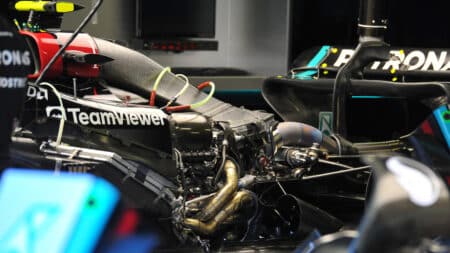
Mercedes is rumoured to have an engine innovation promising a significant advantage over other Formula 1 power units. It could mean rivals are allowed extra benefits to catch up, explains Mark Hughes
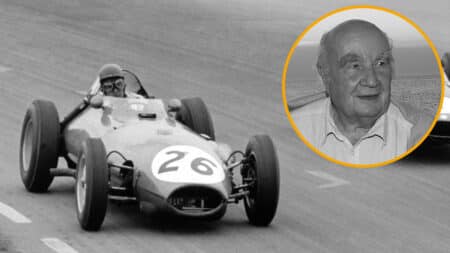
The death last week of Hans Herrmann leaves just four living drivers who raced in 1950s world championship grands prix. The first decade of Formula 1 will soon slip beyond living memory