


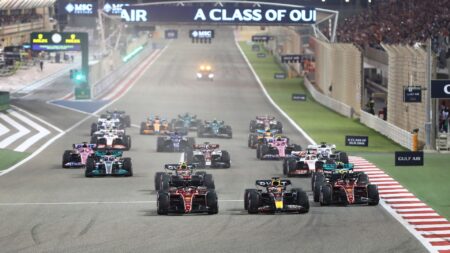
F1
Autolinking test 3: What's new in Formula 1 2023: drivers, team bosses and rules
All the refreshed driver pairings, team principal changes, and subtle regulation tweaks that could shake up the 2023 F1 season

Germany has fallen off the Formula 1 calendar once again, despite the country providing the newest World Champion.
The calendar is reduced to 20 Grands Prix, with question marks still hanging over Montreal and Interlagos – two more of the old, more entertaining, guard. The full list is at the bottom of this page.
Take a look back at five of F1’s greatest German races, chosen via our 100 Greatest Grand Prix special. It’s available to read for free in the Motor Sport app.
Nuvolari’s greatest win. The home favourites were numerous, and hungry; Nuvolari 42 and in an aging and under-powered Alfa. The little Italian outlasted them all – Caracciola, von Brauchitsch, Faglioli, Stuck, Varzi, Rosemeyer – to claim an unlikely victory.
Juan Manuel Fangio’s finest hour. A pitstop lost him almost a minute to the Ferraris of Mike Hawthorn and Peter Collins, but with a lap to go he was back in front. The lap record, his own, shattered on the way by a full 23 seconds, 11 seconds faster than he’d lapped the Nürburgring to set pole.
The daunting prospect of the Nürburgring, pouring, persistent rain; the worst of combinations for safety advocate Jackie Stewart. Yet two hours and 20 minutes later he crossed the line for his greatest win. Four minutes later Graham Hill followed, his nearest challenger.
Another greatest drive, that of Hill. Harried by Gurney and Surtees, he held them at bay by just 2.5s. Jim Clark in fourth drove a wild unfamiliar race, riled by his own startline mistake that dropped him to 10th.
Ten laps of Nuvolari v Caracciola v Rosemeyer. Caratsch retired, leaving the two to duel. And as visibility deterioated Caracciola accelerated. Nuvolari could do nothing but accept second as the German disappeared into the mist.
March 26 – Australia (Melbourne)
April 9 – China (Shanghai)
April 16 – Bahrain (Bahrain)
April 30 – Russia (Sochi)
May 14 – Spain (Barcelona)
May 28 – Monaco (Monte Carlo)
June 11 – Canada (Montreal)
June 25 – Azerbaijan (Baku)
July 9 – Austria (Spielberg)
July 16 – Great Britain (Silverstone)
July 30 – Hungary (Budapest)
August 27 – Belgium (Spa-Francorchamps)
September 3 – Italy (Monza)
September 17 – Singapore (Singapore)
October 1 – Malaysia (Sepang)
October 8 – Japan (Suzuka)
October 22 – USA (Austin)
October 29 – Mexico (Mexico City)
November 12 – Brazil (Sao Paulo)
November 26 – Abu Dhabi (Abu Dhabi)
All the refreshed driver pairings, team principal changes, and subtle regulation tweaks that could shake up the 2023 F1 season
All the refreshed driver pairings, team principal changes, and subtle regulation tweaks that could shake up the 2023 F1 season
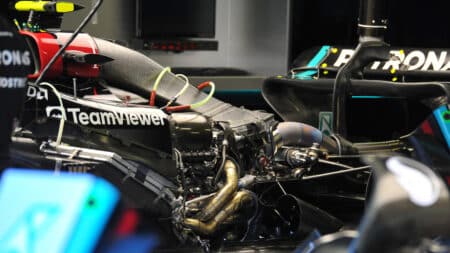
Mercedes is rumoured to have an engine innovation promising a significant advantage over other Formula 1 power units. It could mean rivals are allowed extra benefits to catch up, explains Mark Hughes
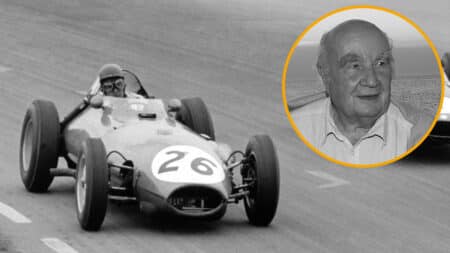
The death last week of Hans Herrmann leaves just four living drivers who raced in 1950s world championship grands prix. The first decade of Formula 1 will soon slip beyond living memory