


F1
F1 car wheel arches tested by Ferrari to combat wet race spray
Wheel arches could be fitted to F1 cars in an effort to reduce the vast plumes of spray that limit visibility in wet races

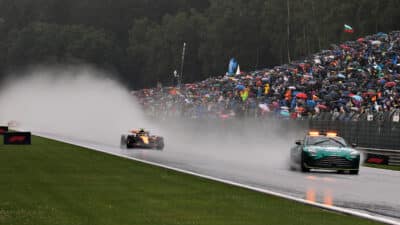
Rain stopped racing in the 2025 Belgian GP
Grand Prix Photo
Formula 1 cars remain among the most technologically advanced on the planet, capable of cornering at incredible speeds and generating more downforce than even most fighter jets.
However, for all their engineering brilliance and incredible speeds, the current F1 single-seaters remain hopeless in one common condition: heavy rain.
As another stormy weekend at Interlagos approaches, F1 still faces major hurdles when it comes to racing on very wet tracks.
The spray generated by the current ground-effect cars, combined with their low ride height means that heavy rain reduces visibility to a minimum, while leaving the cars vulnerable to terrifying high-speed aquaplaning.
Although Pirelli’s supplies blue-walled “full wet” tyres, intended for use in extreme conditions, they are are rarely seen, with safety cars or red flags often bringing racing to a halt before drivers need to switch from the smaller-grooved intermediate tyres.
The current generation of ground effect cars, which eject jets of fast-moving air in an upward surge, have proven effective at converting standing water into clouds of spray, worsening the issue, and there’s no guarantee of a solution — even with a new generation of cars in 2026.
Scroll down for a full breakdown of why Formula 1 cars struggle to race in heavy rain.

Fernando Alonso’s Aston Martin creates its own weather system in Brazil, 2024
Aston Martin
F1 uses two types of wet-weather tyres: the green-walled intermediates, designed for damp or drying conditions. These have shallower tread patterns that flex to generate heat and maintain grip on cooler surfaces where slicks would struggle. Then there are the blue-walled full wets, which feature deeper grooves to channel away standing water and maximise contact with the track in heavy rain.
The tyres themselves aren’t the issue: Pirelli’s full wet tyres — used since the introduction of 18in wheels in 2022 — shift over 85 litres of water per second at 186mph (300km/h), but it’s where the water ends up that causes the problem.
Wheel arches could be fitted to F1 cars in an effort to reduce the vast plumes of spray that limit visibility in wet races
The vast volume of displaced water is spun into the the air as spray behind each car. The modern, wider tyres (405mm vs pre-2017 325mm) reduce visibility far more than in previous eras.
Ground-effect aerodynamics, mandated since 2022, worsen the situation by directing even more spray high into the air, forming a curtain that drivers struggle to see through. It’s the main limiting factor for safe wet racing, often leading to long safety car periods or even red flags in order to reduce the amount of water standing on track.
Even if the car in front can drive safely, the one behind might not be able to react to sudden changes, as seen in the 2025 British GP, where Isack Hadjar crashed into the back of Kimi Antonelli when he couldn’t see the Mercedes in front.
In decades past, F1 accepted these risks and continued grands prix when drivers were effectively racing blind, but an increased concern for safety has imposed a more cautious approach.

Intermediate tyres (left) have shallower grooves than the blue-sidewalled full-wets
Red Bull
While visibility remains the main limiting factor for F1 cars to race under heavy rain, staying in touch with the track is also an issue, especially when water pools on the surface.
Despite the full-wet tyres’ incredible capacity to displace water, they also have their limitations.

Rain all too frequently halts racing in the modern era
Grand Prix Photo
If standing water accumulates faster than the tread can clear it, the car begins to aquaplane — riding on a layer of water rather than the asphalt itself.
The cars’ low ride-height can also create the same effect where the plank underneath the car floats over puddles.
Once that happens, the driver becomes a passenger. A recent example was Charles Leclerc slamming into the wall at relatively low speed as he was on his way to the grid ahead of the season-opening Australian Grand Prix.
Racing’s governing body, the FIA, has trialled wheel arches, which would be fitted to F1 cars when grands prix are red-flagged due to rain, allowing racing to resume much quicker.
The ungainly solution was meant to contain the spray from tyres and was tested at Silverstone in 2023 with Mercedes and McLaren cars fitted with prototype arches. A more extensive test followed in mid-2024 by Ferrari, with real-time visibility analysis and feedback from drivers.

New wheel arches applied just to the rear of Leclerc’s Ferrari
Getty Images
However, it was ultimately a failure. The arches not only failed to make enough of a difference to visibility — they had no impact on the spray produced by ground effect — but they also introduced aerodynamic complications.
“It was quite similar. So I think back to the drawing board, we need to keep looking at it,” Ollie Bearman said last year after testing at Fiorano.
“The visibility was still pretty tough out there. It was slightly better for sure, the work has gone to something, but not fixed. We did four or five runs just trying different levels of openness, because if it (the cover) is fully closed, it’s also quite tough for the temperature of the tyres.”
Next year’s rule reset will cut downforce, and ground effect will be reduced. Wheels will be narrower too (25mm at the front and 30mm at the rear). Both of these measures should reduce the volume of spray in the air, but visibility is still likely to remain minimal when a grid of 22 cars race at speeds of 200mph or more in heavy rain.