Sounds routine enough, doesn’t it? Standard 2025 season fare.
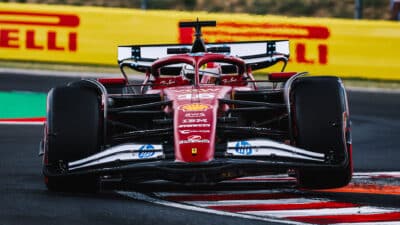
But it wasn’t, not in the way it took shape. There was a Ferrari on pole, for one thing. That could be explained away by the sudden change in wind strength and direction between Q2 – when the McLarens were 0.5sec clear – and Q3. The resultant tailwinds and crosswinds played havoc with the McLarens, which suddenly lost 0.5sec, but not so much Charles Leclerc’s Ferrari, which found 0.1sec to sit itself on pole ahead of Piastri, Norris and Russell.
But the Ferrari was quick in the race too. Or at least in the first stint of what was expected to be a two-stop race, as Leclerc actually built up a small gap over the chasing Piastri.
The twisting, dusty asphalt of Hungaroring rarely made for exciting racing until a layout tweak in the early 2000s set it on a path to being one of F1’s best-loved venues
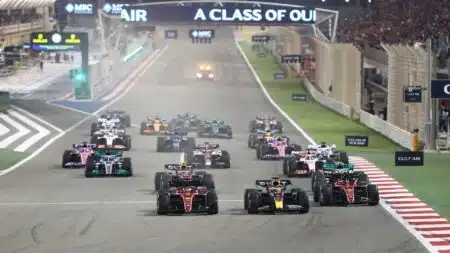
Norris meanwhile had got himself boxed in at Turns 1-2 and muscled down to fifth. Fernando Alonso didn’t make it difficult for Norris to jump up to fourth at the end of the first lap, recognising that his Aston, although much better around this track than Spa, was not up to racing a McLaren without destroying its tyres. But Russell was not so compliant. “We must get by Russell,” urged Norris’ engineer Will Joseph. Easy for him to say… The Mercedes was quick at the end of the straights, running less wing than the McLaren. As it gradually fell back from Piastri, so Norris was falling back with it.
Leclerc had the gap over Piastri out to 3sec as the first pit stop window opened. The Ferrari was out of Piastri’s immediate undercut range. McLaren was shocked – and even began thinking about trying to beat Leclerc on strategy. What did Oscar think of the idea of a one-stop he was asked on lap eight? “I don’t know at this stage,” countered the driver.
McLaren’s Australian charge committed to a two-stop, meaning he had to pass cars on track
McLaren
How could this be? The best working theory for why the Ferrari was initially so fast, but in subsequent stints much slower, came from Russell. “The only thing we can think of is they were running the car too low to the ground and they had to increase the tyre pressures for the last stint – and they were using an engine mode that was making the engine slower at the end of the straights, which is where you have the most plank wear.”
This did fit with observed patterns. The Ferrari’s underbody was sparking extra heavily in the early laps when loaded with fuel and before the tyre pressure have come up fully. The car was slower on its second set of tyres – allowing Piastri to close up but not pass – and much slower on its third set, allowing Piastri to pass it at the end of the pit straight where earlier it had been so much faster. Russell followed him by a few laps later.
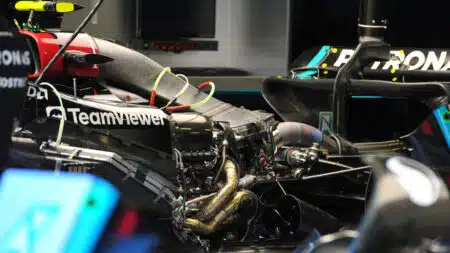
F1 drivers have been complaining about the heavy, technical cars they’ll be racing from 2026. Now a tantalising glimpse of a smaller alternative has emerged
By
Dominic Tobin
It’s only a theory and Leclerc afterwards – having spoken with the team – was backpedalling and insisting it was a chassis problem. Regardless, spending 50 of the race’s 70 laps in Leclerc’s dirty air had left Piastri coming out from his second stop 12sec behind Norris who had used the clear air after the two-stoppers made their first stops to nail a very fast and consistent pace.
There were 25 laps left for Piastri to pass Leclerc – which he did quite effortlessly shortly after rejoining – and catch Norris. His tyres were 14 laps newer, allowing him to get on the other McLaren’s tail with four laps to go. But this is such a difficult place to follow, with its long corner onto the pit straight losing the following car a lot of downforce. The DRS then just reclaims that. “I’d have needed brand new softs to have passed him,” reflected Piastri later. He came close to taking them both out a couple of laps from the end, all locked up and on an apparent collision course into Turn 1, but rescued the moment.
Russell had his own theories on what happened to Ferrari and Leclerc
Ferrari
“I didn’t really expect it to work,” said Norris of his strategy. “I was a long way behind by the time we committed to the one-stop. I pushed like hell trying to pass George but couldn’t. Then the end of the first stint was great and I managed tyres perfectly in second stint. But the one-stop was just to get me back into things. I thought it might get us second.”
He heads into the summer break having narrowed his deficit to Piastri to nine points.
In previous lives Mark raced cars, worked at Jim Russell racing school, got a university degree which he never used, tried working in industry, didn’t like it, left and joined Motoring News in 1988 as a junior club race reporter. Went freelance in ’96, concentrated on F1 from 2000. Grand Prix editor of Autosport for 10 years.