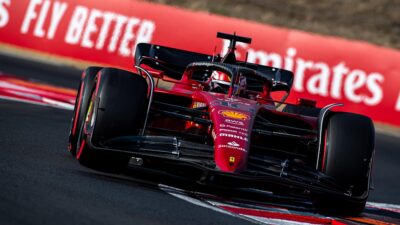
Mercedes and Red Bull devised strategies to avoid the hard tyre at the 2022 Hungarian Grand Prix after realising it would ruin their races, but Ferrari had no idea. Mark Hughes explains why
Leclerc in Friday practice: a final sighting of a fast Ferrari
Red Bull’s Max Verstappen, from tenth on the grid, had this race won with 25 laps still to go. Coming into the weekend Red Bull was pretty sure the Hungaroring’s layout, the short straights, the way it rewards a strong front end response and acceleration out of the turns, was almost tailor-made for the Ferrari. For Red Bull, sitting pretty on a big lead in both championships, Hungary was just going to be about damage limitation.
Sure enough, in the sweltering heat of Friday, Ferrari was 0.3sec clear of Red Bull over a lap and around 0.9sec faster over a race stint simulation.
Verstappen and Perez said, no way was the hard going to be viable
That’s the last we saw of a fast Ferrari. The change from a sweltering Friday to a cool, damp Saturday and Sunday swung things around dramatically. Maybe Ferrari didn’t have as good a read as Red Bull on what it needed to do to keep its car in its sweet spot as conditions changed so radically. The fact that FP3 on Saturday morning was rained out meant this wasn’t discovered until qualifying, where George Russell’s Mercedes pipped the Ferraris to pole. Ferrari had probably got away with being punished further by the power unit glitch Verstappen suffered in Q3, leaving him without a proper time and starting 10th. And maybe by Lewis Hamilton’s DRS failure on his only new-tyred Q3 lap in the other Mercedes, which caused him to abort and line up only seventh.
But even though the Ferraris started second and third, they had no real pace on race day either. On any of the three tyre compounds. The Red Bull – or Verstappen’s at least, because Sergio Perez was nowhere this weekend, not even graduating from Q2 – was conclusively quicker than anything else out there. On the medium tyre the Ferrari was maybe slightly faster than the Mercedes, but definitely slower than the Merc on the soft. On top of that, Ferrari used the hard tyre on Leclerc’s car – and it was a disaster. Mercedes had understood on Friday that a hard tyre struggling on a track temperature of 47C was going to be even worse on a track 20C cooler on race day and so they avoided it at any cost. That put them unambiguously on a two-stop strategy.
The makings of a disaster as Ferrari fits hard tyres to Leclerc’s car
Peter J Fox/Getty Images
Unlike Mercedes, Ferrari hadn’t even tried the hard on Friday. Nor had Red Bull. But the expectation was that – as usual – the hard would be a little slow to warm up but become good after a few laps, especially on a rubbered-in track. But it was way worse than that. Red Bull at least discovered this on the reconnaissance laps to the grid. Both Verstappen and Perez, after struggling to get heat even into the soft, said, no way was the hard going to be viable and the Red Bull plan to one-stop around starting on the hard was immediately abandoned. They would start on the soft – like Russell – and two-stop.
Hamilton was put onto the medium for the start because – lined up as he was in seventh – the probability of him getting past two Alpines and a McLaren on the opening lap was deemed slim and so there’d be more advantage in being able to run long than being briefly quick but thwarted off the grid.
Ferrari’s ability to self-sabotage knows no bounds, and the Hungarian Grand Prix is the latest in a long list of examples. And it comes against the backdrop of a team…
By
Chris Medland
Although Russell and the Ferraris – Carlos Sainz ahead of Charles Leclerc – ran away at the front in the first stint, that was only because Lando Norris on his soft tyres had been able to stay ahead of Hamilton at the start. And because Verstappen, taking things very cautiously on the opening few corners, had to find his way around two Alpines before he even got up with Hamilton.
Hamilton went by Norris on the 12th lap as the McLaren’s tyre grip faded and was followed through immediately by Verstappen and Perez. But it had taken most of the first stint for the races of Hamilton and Verstappen to properly begin. By which time Russell, with the closely-following Ferraris, was 11sec up the road.
As Russell’s softs faded and the medium-shod Ferraris closed in, as soon as there was a gap to drop him into – on lap 16 – Russell was brought in for mediums. Eleven seconds back, Red Bull brought Verstappen – whose softs were also just beginning to fade – in to undercut him past Hamilton. Mercedes left Hamilton out there for another three laps – until a Perez undercut threat brought them in.
Ferrari would have left Sainz out there too, except Russell had suffered a 2sec delay at his pit stop, inviting Ferrari to overcut Sainz past by pitting on the next lap. That would have worked if Sainz had not suffered almost as big a delay as Russell at his stop. Ferrari had prioritised Sainz’s track position over the ideal tyre stint spacing – but hadn’t taken the track position! The worst of both worlds. The delay not only ensured he didn’t pass Russell, but that he’d later lose a place to Leclerc. But at least he definitely knew he was now two-stopping, as his mediums had been replaced by another set and there’s a requirement to use at least two compounds.
Leclerc stayed out until the 21st lap and with the extent of everyone’s tyre deg now evident and the obligation to two-stop, he was put onto another set of mediums. Which put Russell back into the lead from Leclerc and Sainz, but Verstappen now fourth and only 7sec behind.
Leclerc would find his way past Russell but it was a false dawn
Antonin Vincent / DPPI
Leclerc, with tyres five laps newer than Russell’s, caught and passed the Mercedes. Behind, as Verstappen closed down on Sainz, he kept that 7sec gap to the lead stable. As soon as he was within undercut range of Sainz – on lap 38 – he was brought in, for fresh mediums on which to get to the end. Sainz stayed out, trying to run long enough to get onto softs. Leclerc and Russell were pitted in response, Russell to maintain track position over Verstappen (which he didn’t do thanks to Verstappen’s stunning out-lap pace), Leclerc to maintain position over Russell.
This was when Leclerc was fitted with the disastrous hard tyres. This in combination with Verstappen’s jumping of Russell brought the Red Bull into serious victory contention. Leclerc had no traction, no grip and no matter how long he ran them, the hards would just not reach their operating temperature. Verstappen was soon all over him. He passed under DRS, before spinning through 360-degrees a few corners later, allowing Leclerc ahead once more. But it took only another four laps before Verstappen repeated his pass. Sainz had managed to stay out leading long enough to get onto the softs for his final stint but not at a pace good enough to remain ahead of Verstappen and Leclerc after he stopped on lap 48. This race was now Verstappen’s.
Verstappen spin allowed Leclerc back in front… for four laps
DPPI
Behind him, Russell was catching Leclerc but being caught by Sainz – with Hamilton (like Sainz, on softs for his final stint) – catching them all. Hamilton’s pace on the softs was around 1sec faster than Sainz’s and he set the fastest lap of the race in his chase. Russell passing Leclerc was the trigger for the latter to abandon the hards and pit a third time – putting him sixth, behind Perez. Hamilton passed Sainz and a couple of laps later did the same to team-mate Russell for second.
A long way behind the top three teams, Norris’s McLaren had a fairly lonely run to seventh, well clear of the one-stopping Alpines of Fernando Alonso and Esteban Ocon, with Sebastian Vettel taking the final point in his Aston Martin.
In previous lives Mark raced cars, worked at Jim Russell racing school, got a university degree which he never used, tried working in industry, didn’t like it, left and joined Motoring News in 1988 as a junior club race reporter. Went freelance in ’96, concentrated on F1 from 2000. Grand Prix editor of Autosport for 10 years.