


Archive
Sun rises on new LMDh era at 2023 Daytona 24 Hours
There were just 26min left on the clock, the green flag dropped and the four cars on the lead lap raced to the finish. Just 11sec separated them at the…


Some IMSA bosses can't envisage privateer teams being able to take on the manufacturers
Julien Delfosse / DPPI
Top IMSA sports car team bosses Bobby Rahal and Wayne Taylor have warned that hopes for a new golden age of top-level endurance privateers may be vain, warning that it will be “very hard” for any entry without significant manufacturer backing to win.
All eyes are on the highly anticipated World Endurance Championship season-opener at Sebring this weekend, the first race to see Hypercars take on LMDh machines in the biggest top-class entry in years.
The ACO’s convergence with the US-based IMSA endurance series on the new, relatively ‘cost-effective’ LMDh regulations – allowing both these and Hypercars to be raced in the same championship – were produced with the aim of fostering packed top tier fields on both sides of the pond, as was seen at Le Mans, Daytona and Sebring in the 1980s.
LMDh rules require manufacturers to choose a chassis from a choice of four, and use a standardised hybrid system – all done with the intention of controlling costs.

ACO and IMSA are hoping for privateer-packed field similar to sports cars’ ’80s heyday
Klemantaski Collection/Getty Images
JOTA, Proton and JDC Miller have all been announced to be running privateer Porsche 963s later this season, with Pescarolo set to be utilising at least one customer Peugeot 9X8 Hypercar next year.
However, 1986 Indianapolis 500 champion and IMSA race-winner Rahal – whose Rahal Letterman Lanigan squad runs the BMW IMSA factory effort – told Motor Sport that the idea of a privateer buying an off-the-shelf LMDh car and fighting with the top teams is likely to be a fallacy.
“I personally think that it will be hard for privateers to succeed, to win,” he said.
“With IMSA in the 80s, when you had the 962s, you were kinda racing against the Porsche factory because that was Al Holbert, but there wasn’t much difference [between that and privateer teams].
“A number of privateer Porsches won races, [such as] Bruce Leven’s team, I won five races in the 962 there were others – it was pretty competitive.
“But then when you brought Nissan, Toyota, Jaguar in [in the late ‘80s], all of a sudden the game changed. So we’re kind of back to that to some degree.”
Rahal says the outlook isn’t good for privateers in this new era of sports car racing.
“I know the intent was for it to be a more cost-effective category,” he says. “I just don’t see that happening.
“If only because you have BMW versus Porsche versus Cadillac versus Acura versus Lamborghini [from 2024].
“The cars are very complex – and complexity equals money. At this stage of the game, I don’t see this as being a more affordable alternative to say [previous IMSA formula] DPI, for example.
“It might be [affordable] compared to LMP1, but now you have Hypercars, you’ve got Ferrari, you’ve got Toyota. These people want to win races – and that costs money.”

RLL is running the BMW effort with considerable backing
Getty Images
Daytona-winner Wayne Taylor, whose eponymous squad – along with Meyer-Shank – has the backing of Honda brand Acura, concurs with Rahal, and explained to Motor Sport what is likely to stymie the privateer efforts.
“It’s going to cost a lot more than everybody was expecting”
“I think it’s going to cost a lot more than everybody was expecting,” he said referring to the ACO and IMSA rule-makers.
“Talking to my vice president Travis Houge, he said we’ve gone from paying 15 cents a litre to 34 cents a litre [for fuel]. For the race we’ve gone from having 35 or 36 sets [of tyre] allotments to only 30 – but those are costing more than our tyres last year. Everything has gone up.”
Heading into Daytona, tension mounted as to whether there would be enough of the Acura LMDh cars left to make it through the weekend – another pressure which can be sustained by manufacturers, but would be difficult for privateers – even when the cars are older and more parts are available.

Jenson Button will compete in three NASCAR Cup Series races this year, as well as at Le Mans in a (modified) stock car. it all stems from watching Tom Cruise in Days of Thunder as a youngster, he says
“We’ve never come into a 24-hour race ever with so little [an] amount of spares,” Taylor told IMSA prior to the event, before elaborating further to Motor Sport.
“We still don’t know how much wear and tear these cars are gonna take before we have to replace parts.
“By the looks of things, we’re going to be going through a lot more than we thought we would. And that costs money.”
Taylor agrees with Rahal a manufacturer budget which is required to shoulder the challenge.
‘It’s definitely become more manufacturer-based and of course they have bigger pockets than privateers, and [more] sponsors. It’s definitely made it harder to be a team owner without big support from a manufacturer.
“You certainly have to surround yourself with good people that have got resources, which is why Andretti Autosport and I got together to form a long-term partnership.”
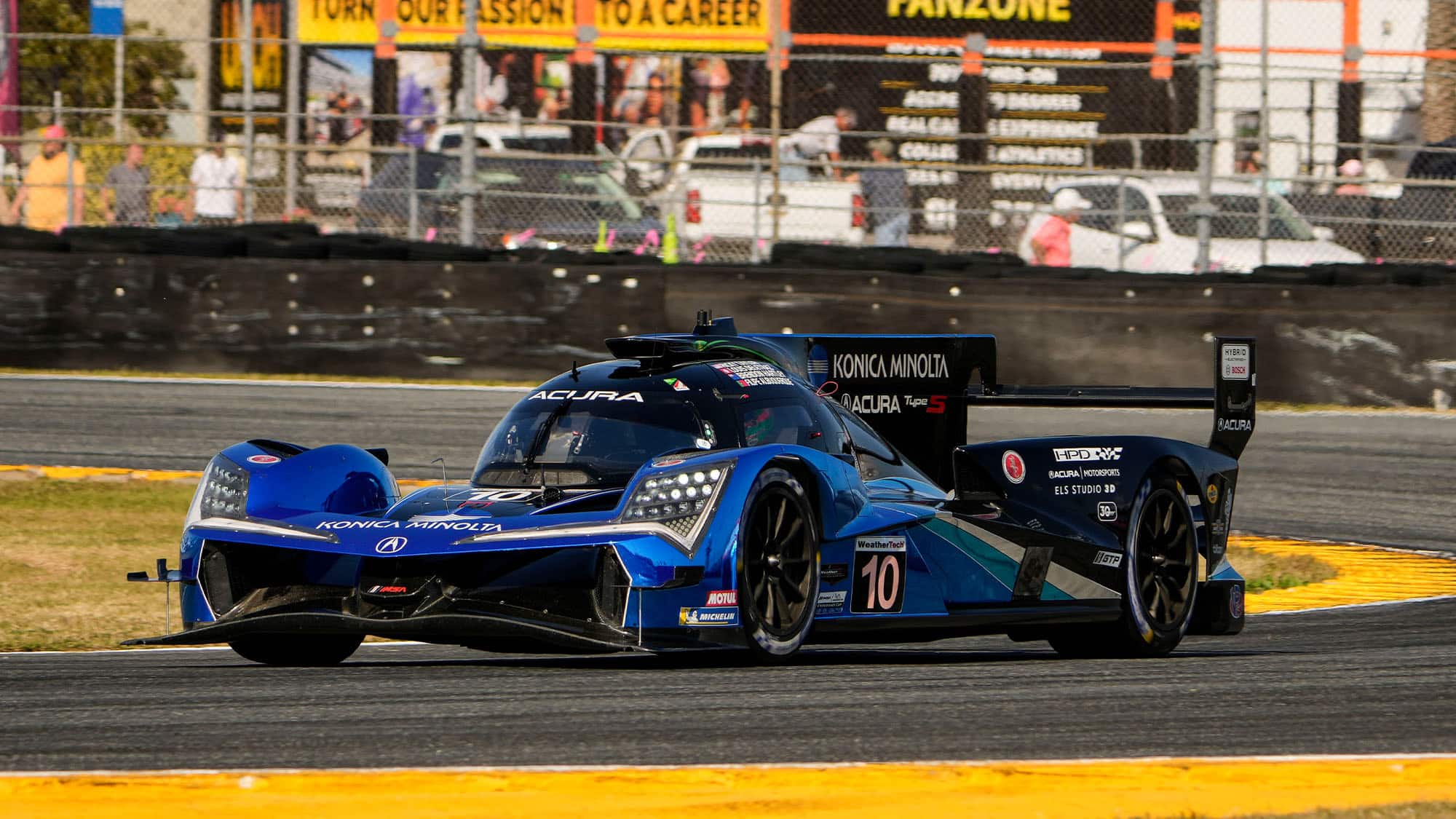
Michael Andretti and Taylor both have long-held ambitions to succeed at Le Mans, though no plans have yet been confirmed by Acura. Taylor says budgets would have to balloon further with the ACO’s stipulation that any team wishing to enter Le Mans must have at least one car entered for the full season of WEC.
The South African is not averse to the idea of a cost cap, but appreciates it’s murky regulatory water.
“I think they should [introduce a cost cap], I just don’t know how they do that,” he says. “You saw what happens in Formula 1 [Red Bull’s cost cap breach].”