


Indycar Racing News
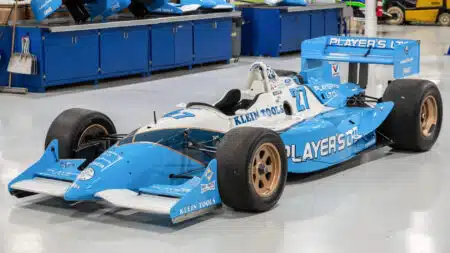
Jacques Villeneuve's championship-winning IndyCar up for sale
The car in which Jacques Villeneuve made his name on the international racing scene is now going under the hammer

In April I wrote about Bill Vukovich and Parnelli Jones, two of the greatest Indy 500 winners in one hundred years of the Indianapolis Motor Speedway. This week I write about Frank Lockhart, rookie winner of the 1926 Indy 500, whose flame burned intensely for a short period – less than two years – but left a great legend. Indeed, it can be argued that no other Indy 500 star achieved more in such a short time.
Frank Lockhart in 1926
Lockhart became the youngest winner of the 500 at his first try, aged 24. He started racing in 1923 when he was 20 years old, driving his own modified Model T Ford. Running on dirt tracks in Southern California he immediately showed his talent, and in 1925 Harry Miller gave him a 3-litre Miller dirt racer with which young Frank scorched the west coast’s dirt tracks. Miller hired Lockhart as a back-up or relief driver for the 1926 500, but before qualifying Frank replaced independent Miller driver Pete Kreis who was sick with the ’flu. Lockhart set a lap record on his first of four qualifying laps but a tyre failure stopped him on his second. A second qualifying attempt was aborted by engine failure and in the end Lockhart qualified 20th.
On race day he quickly moved up the field, taking the lead before rain stopped play. After a restart Lockhart battled with Harry Hartz, who had finished second in the 500 in 1922-23 and would subsequently win the 1926 AAA championship. But Hartz flubbed a pitstop, leaving his ignition turned off. It was Lockhart’s opportunity to run away, and he was leading by two laps when the race was cut short by a second bout of rain after 400 miles. For a quarter of a century, until a 22-year-old Troy Ruttman triumphed in 1952, Lockhart was the youngest Indy winner.
1922 Indianapolis start
With his prize money Lockhart bought his own cars and started modifying them in ways that upset Harry Miller, but Frank pushed on, making his own improvements to engines and superchargers. Among other things he devised an intercooler for his supercharger which gave more power than the conventional Miller system, and he went on to win nine more AAA Championship races over the next 17 months, establishing himself as the most feared driver of the times. He also won another 10 non-championship dirt track races.
Lockhart’s meteoric rise occurred in the midst of America’s great board track era, known as the ‘Golden Age’, with titanic struggles between teams from Miller and Duesenberg on tracks in places like Beverly Hills, Los Angeles, Charlotte, Miami and Atlantic City. In May 1927 on the 1.5-mile Atlantic City board track, Lockhart set a qualifying record of 147.729mph with his supercharged 1.5-litre Miller. Thirty-three years would pass before any driver lapped another American superspeedway quicker.
At Indianapolis in 1927 Lockhart qualified on pole at a record-setting 120.100mph, the first man to break the 120mph mark at the giant 2.5-mile superspeedway. In the race he ran away on his own, leading 109 laps before his engine threw a connecting rod. During the second half of the season Lockhart won five races, although Pete DePaolo beat him to the AAA title.
But Lockhart didn’t make it to the 1928 Indy 500, crashing to his death on April 25 that year while trying to set the Land Speed Record on Daytona Beach aboard the remarkable twin-supercharged V16 Stutz Black Hawk, which he had designed and built. Lockhart’s elegantly streamlined, 2700lb car represented a revolution in size compared to the lumbering behemoths which dominated record runs of the days in the hands of Englishmen Henry Segrave and Sir Malcolm Campbell, and American Ray Keech.
Frank Lockhart in Victory Lane in 1926
Lockhart first ran the Black Hawk on the Daytona sands in adverse weather on February 28, only to crash into the sea. Two months later he was back for another try but a rear tyre exploded while he was doing an estimated 225mph. The Black Hawk snapped sideways and then tumbled into a lurid series of rollovers. This time there was no escape. The great Lockhart’s life was over at a mere 26 years of age.
All photos courtesy of Indianapolis Motor Speedway.
The car in which Jacques Villeneuve made his name on the international racing scene is now going under the hammer

From Japan to Mexico, Surfers Paradise and Milwaukee, we chart the best onboard racing shots caught in 2025

Mick Schumacher says he's looking forward to making a difference in super-competitive IndyCar – and says the risk is all part of the fun

Mick Schumacher has followed the American Dream by heading to IndyCar: Can he match other F1 aces that have succeeded Stateside?