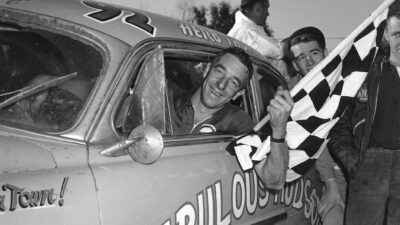
The Hudson Hornet is known for its role in Disney film Cars but the story that inspired it is just as compelling: here's how Herb Thomas raced the legendary car to two NASCAR titles and missed out on a third in controversial circumstances
Hudson Hornet powered Herb Thomas to two NASCAR titles
The championship leader going in lay comatose after a pile-up triggered by his main rival’s team-mate – in a race lately added to the list and guaranteed by his recently estranged team boss.
Kiekhafer was a NASCAR sophomore; the owner of its first professional outfit; and desperate to win consecutive championships.
Thomas at Daytona Beach in 1949
ISC Archives/CQ-Roll Call Group via Getty Images
This unlikely pair had joined forces early in 1956 – money talks – but despite three wins on the bounce in May/June, the quiet North Carolinian quickly wearied of his boss’s sometimes intrusive whims and caprices and – as had reigning champion Tim Flock – quit the team.
He preferred being his own man – albeit often with help from the most famous and craftiest of crew chiefs. Thomas’s happier partnership with ‘Smokey’ Yunick had put the ‘Fabulous’ in the legendary Hudson Hornet.
Marshall Teague is famous for his ‘Fabulous Hudson Hornet’ that put NASCAR on the map and on a commercial footing in the early 1950s. But he was killed in a…
By
Paul Fearnley
It was Marshall Teague who had recognised the competition potential of this sturdy and streamlined coupe, low-slung and, thanks to a 5-litre side-valve straight-six, sufficiently powerful and torquey. Having persuaded Hudson to provide technical support – a NASCAR first – he convinced Thomas to ditch his Plymouth midway through 1951.
Thomas’s Hudson retired first time out because of overheating – but after modifications he used it to win the Southern 500 at Darlington, and thereafter went on a late tear that swept him to the title.
The following year he was matched in terms of wins – eight apiece – but shaded by 106 points by Flock, also driving a ‘step-down’ Hornet.
This amazing run ‘ended’ with a classified fifth place in the Southern 500 – having led 124 laps and retired because of engine failure with just 10 (of 364) to go.
That second title was but a formality, sealed by back-to-back victories at Bloomsburg and Wilson.
Thomas – at Jacksonville – took a second Southern 500 victory in 1954 but missed out on the title
ISC Archive via Getty Images
Thomas matched that record round-dozen win count – which included his second Southern 500 victory – in 1954, but this time was shaded by 283 points, by the consistent Lee Petty.
The Hornet was losing its sting. Hudson lacked the finances and resources to capitalise on its racing successes and, squeezed ever more tightly by the Big Three in an increasingly buyers’ market, had begun the death spiral that would see it cease production before the decade’s end.
Thus Thomas was at the wheel of a Buick when he suffered the injurious crash at Charlotte that cost him three months of the 1955 season.
He not only promised to return but also to do so as a winner.
Thomas rolls his Buick at Charlotte, putting him out of the 1955 season for three months
ISC Images via Getty Images
His third Southern 500 victory was achieved with Yunick’s unfancied Chevrolet 150’s blend of Utility Sedan and Super Power Pack options – plus whatever else lay secreted within. An excellent judge of pace, Thomas gradually overhauled more powerful, bigger and thirstier machinery — including Kiekhaefer’s — by completing the distance on a single set of Firestones.
He started the 1956 season – in November 1955! – as the championship favourite, an expectation reinforced by his switching in April to Kiekhaefer’s Ray Fox-tended Chryslers and Dodges.
His last edge of speed might have been dulled by the accident, but Thomas remained a fierce competitor to be reckoned with.
The first NASCAR ‘Strictly Stock’ race: unruly gathering for 1949 Charlotte meet
By
Gordon Kirby
Although his victory at Merced, California – from the last of his 39 pole positions – would remain the 48th and last of his career, his consistency back behind the wheel of his Chevrolet meant that he stood atop the points with four rounds (of 56!) remaining.
Thomas was closing on Baker at mid-distance in this 100-miler when Speedy Thompson, whom he had overtaken for second place, turned him head-on into the wall. The Chevy went in hard and was collected by several of the chasing pack.
Baker won and, though still lagging in the overall standings, was now faced with an open goal while Thomas was in hospital. He didn’t miss.
It was, however, a Pyrrhic victory.
The fans smelled a rat and Kiekhaefer, whose sledgehammer approach had done little to endear him to them, became Public Enemy Number One. Already often at strident odds with NASCAR founder Bill France, and also now worried that the negative publicity might adversely affect his business, the 1957 season – and all others thereafter – would start without him.
Thomas in No92 Chevy at Daytona, ’56. He led the championship but lost out in a controversial end to the season
Hy Peskin/Getty Images
Thomas attempted a return that year but managed just two uninspiring starts in Ray Fox-run Pontiacs.
He was interested in only one thing – his 21 per cent win ratio remains a record for NASCAR drivers with more than 100 starts – but not at all costs.
He returned to his family’s farm and kept a low profile while oozing jokey contentment. He listened to the races on the radio and later watched on TV – cheering always for Dale Earnhardt – but rarely spoke of his own.
He died of a heart attack in August 2000.
Marshall Teague (left) with race winner Thomas at 1951 Southern 500
ISC Images via Getty Images
His story has been told in a manner of speaking by Doc Hudson in the 2006 animation Cars; Thomas was the inspiration for the Paul Newman-voiced character that mentors the film’s hero Lightning McQueen.
It is difficult to know what he would have made of that quirky honour – and likely that very few cinemagoers made the connection in any case.
Which is a shame because none other than Richard ‘The King’ Petty – aka Strip ‘The King’ Weathers in the film – reckons that Thomas “was as good as they come.”
Having spent much of his formative years soaked and sideways in his father’s 1933 Frazer Nash TT Replica, Paul has long been in thrall to old cars and past – and current – motor racing. He joined Motoring News as junior rally reporter in 1990 and went freelance in 2005, having edited Motoring News, F1 Racing and Motor Sport in the meantime.