

We would like to send you notifications with the latest news and updates from MSM OK No thanks

Top 10 most expensive cars ever sold at auction

1.1955 Mercedes-Benz 300 SLR Uhlenhaut Coupe

Auction house RM Sotheby’s  /  Location Stuttgart
Year sold 2022  /  Sold for $143,000,000
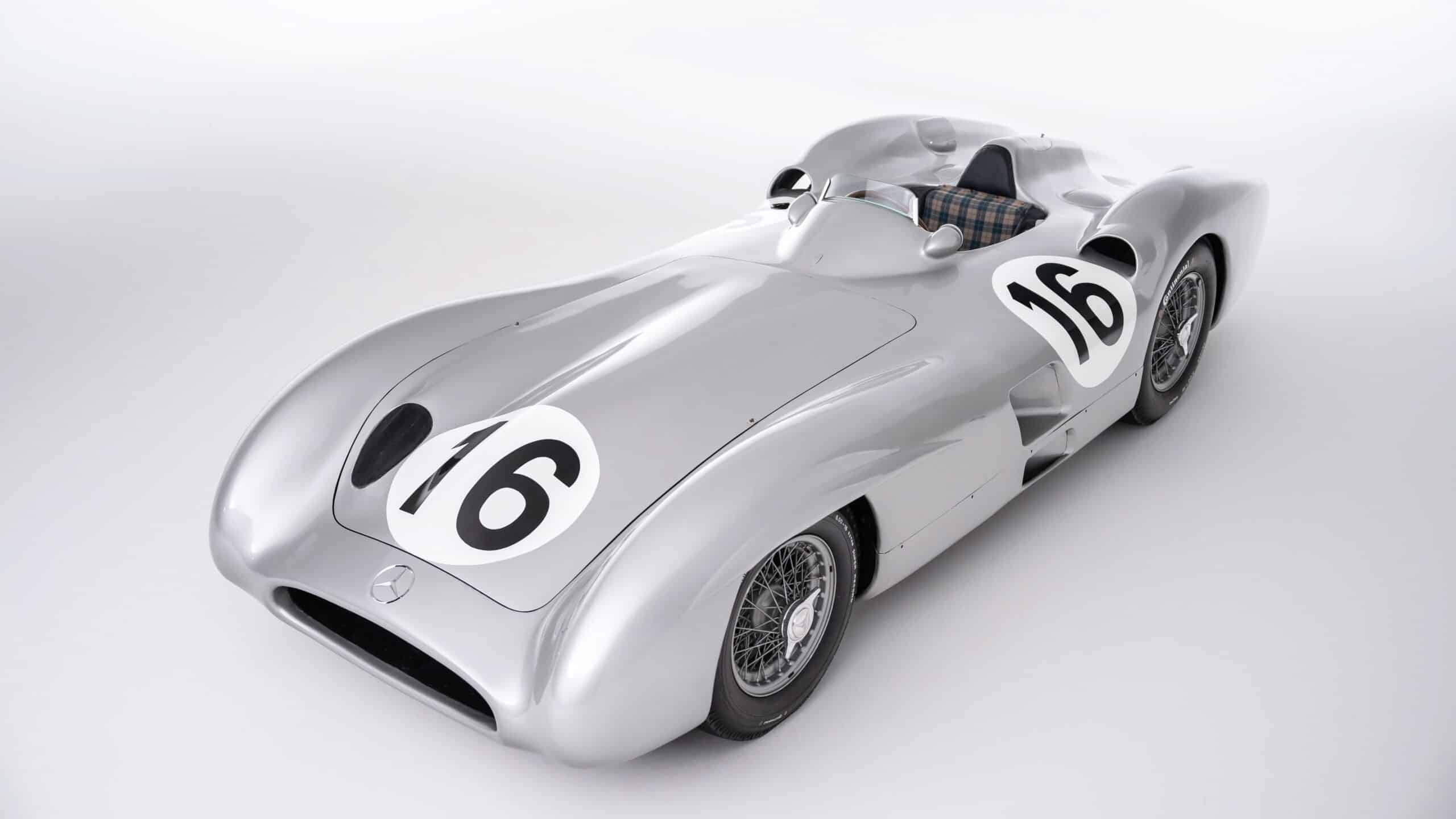

1954 Mercedes-Benz W196 R streamliner

2. 1954 Mercedes-Benz W196 R streamliner

Auction house RM Sotheby’s Location Stuttgart 
Year sold 2025 / Sold for $53,917,370


1962 Ferrari 330 LM 250 GTO by Scaglietti

3. 1962 Ferrari 330 LM 250 GTO by Scaglietti

Auction house RM Sotheby’s / Location New York
Year sold 2023 / Sold for $51,705,000


1962 Ferrari 250 GTO

4. 1962 Ferrari 250 GTO

Auction house RM Sotheby’s / Location Monterey
Year sold 2018 / Sold for $48,405,000


1962 Ferrari 250 GTO

5. 1962 Ferrari 250 GTO

Auction house Bonhams / Location Monterey
Year sold 2014 / Sold for $38,115,000


1964 Ferrari 250 LM by Scaglietti

6. 1964 Ferrari 250 LM by Scaglietti

Auction house RM Sotheby’s / Location Paris
Year sold 2025 / Sold for $36,344,960


1957 Ferrari 335 Sport Scaglietti

7. 1957 Ferrari 335 Sport Scaglietti

Auction house Artcurial / Location Paris
Year sold 2016 / Sold for $35,821,289


1967 Ferrari 412P Berlinetta

8. 1967 Ferrari 412P Berlinetta

Auction house Bonhams / Location Monterey
Year sold 2023 / Sold for $30,255,000


1954 Mercedes-Benz W196

9. 1954 Mercedes-Benz W196

Auction house Bonhams / Location Goodwood
Year sold 2013 / Sold for $29,650,095


1956 Ferrari 290 MM

10. 1956 Ferrari 290 MM

Auction house RM Sotheby’s / Location New York
Year sold 2015 / Sold for $28,050,000 

Special Issue Contents Archive - Motor Sport Magazine
We would like to send you notifications with the latest news and updates from MSM OK No thanks

Top 10 most expensive cars ever sold at auction

Since it opened in 1956, the Indianapolis Motor Speedway Museum has been a world-wide draw for automotive fans. For almost seven decades its curators have sought to gather some of the finest and most historic collector cars in the world, gradually growing its exhibits from 12 cars to a collection of over 300. The recent decision to refocus the museum toward cars that share an intrinsic link with The Brickyard proved a turning point, meaning several of its incredibly rare pieces had to find new homes. Enter RM Sotheby’s, which auctioned 11 landmark vehicles across a series of events in February 2025. Some of these made history, such as the 1954 Mercedes-Benz W196 R Stromlinienwagen and Le Mans-winning 1964 Ferrari 250 LM, both profiled earlier in this issue. These are the rest of the collection. In total, lots from the Museum raised over $120m.


Mercedes 17.3-litre 150 HP ‘Brookland’ Semmering Rennwagen

Year 1908  /  Price $8.255m

Yes, you read that right. Seventeen-point-three litres. Engineers were ambitious animals during the dawn of the 1900s, and this one-off factory-built racer epitomised the quest for power of the time. With the mighty (and one-off!) 17.3-litre four cylinder mounted up front, it was built to take on the Semmering Hill Climb in Austria, at the time one of the world’s most gruelling competitions.

“Its provenance is unquestionable… even its cylinders are individually dated”

Driver Otto Salzer conquered it, achieving a new record of 81.2kph. He then improved that to 84.3kph on his way to a second victory a year later. The car then changed ownership a handful of times before being acquired by the Museum for an eye-watering at the time $30,000 in 1964. Its provenance is unquestionable, with its original chassis tags, numbered radiator and carburettor… even its cylinders are individually dated.


Laurin & Klement Type S2 Sportswagen

Year 1911  /  Price $179,000

Laurin & Klement was a Prague-based constructor that operated only between 1906 and 1928, but despite its short lifespan it did leave a lasting impact on the automotive world by gradually evolving into Škoda. Only three of these twin-cylinder four-stroke machines were ever made, and this is the sole survivor. But it got more interesting after the modifications made by its first owner, Baron Leo Haan. A seasoned racer, he fitted a wooden rudder behind the tail linked to the steering, allowing the rudder to change direction with the car and provide side force, preventing skidding around turns. After some success in hillclimbs, the Baron sold it to Günther Heger, who stored it for 40 years before offering it to the Museum in 1964. Almost entirely original and unrestored aside from a light mechanical refresh. A sales note suggested rebuilding the original wooden wheels should its new owner fancy running it in anger.


Mercedes 22/40 HP ‘Colonial’ Double Phaeton

Year 1911  /  Price $268,800

A superb early example of luxury motoring, Mercedes’ 22/40 PS (40 HP for the American market) is powered by a 5.6-litre T-head four-cylinder engine. Buyers had the choice of a modern shaft drive or a classic ‘Colonial’ chain drive that offered greater ground clearance. Given that this particular example ended up in Buenos Aires, Argentina, the chain-drive option was fitting. First ordered by Robert, Pusterla y Cía (an Argentine Mercedes dealer) it came with paperwork covering its life in South America and resulting transit to the USA after being bought by the Museum following long-running negotiations in 1971. While restored, the car retained its original carburettor, ignition system, switch panel and even driver’s side flooring and chassis tags.


Benetton B191

Year 1991  /  Price $775,000

Perhaps an odd acquisition given Formula 1 boasted only one American race in 1991, and that was in not-so-nearby Phoenix, Arizona. However, it’s the link to all-time grand prix great Michael Schumacher that temped the Museum to invest in this piece of rolling history. When Roberto Moreno got the boot it opened the door for Schumacher to settle in for the final five races of 1991, fresh from his grand prix debut with Jordan at Spa. Chassis B191-08 took Schumacher to fourth in the opening race of 1992 before being handed to Martin Brundle. It scored three points toward the 1992 drivers’ and constructors’ championships before being retired in favour of the updated B192. The Museum bought it in 2005 from a US-based private collector.


Chevrolet Corvette SS Project XP-64

Year 1957  /  Price $7.705m

Like something out of The Jetsons, and billed as the most desirable Corvette in the world. This was the first purpose-built GM race car and a personal project of Zora Arkus-Duntov, the engineer nicknamed the ‘Father of the Corvette’. Powered by a 283cu-in V8 and with a four-speed manual gearbox it is an exercise in lightweight construction with stunning magnesium bodywork. John Fitch and Piero Taruffi raced it in the 1957 Sebring 12 Hours, it was also once a cover star for Sports Illustrated magazine. Barring the SS show car, this was the first Corvette to run with the famous Super Sport badging. Arkus-Duntov himself brokered the car’s donation to the Museum in May 1967.


Ford GT40 Mk II

Year 1966  /  Price $13.205m

“It had resided at the Museum since its donation in March 1968”

It may not be wearing an iconic livery, but this GT40 is one of just eight 7-litre MkIIs and came with superb provenance. Driven to second place in the 1966 Sebring 12 Hours by Walt Hansgen and Mark Donohue, it then went on to race at Le Mans that year as one of three Holman-Moody entered cars.

It had resided at the Museum since its donation in March 1968, and has been fully restored in 2011 to its Le Mans ’66 configuration. Prior to its sale, it was last shown outside of the Museum at the 2011 Concours d’Elegance of America.

1966-Ford-GT40-Mk-II_1284802

Ford

1966-Ford-GT40-Mk-II_1284834

Ford

1966-Ford-GT40-Mk-II_1284787
1966-Ford-GT40-Mk-II_1284786


Spirit of America Sonic 1

Year 1965  /  Price $1.325m

“Sonic 1 took Craig Breedlove to a staggering 600.601mph in 1965”

Perhaps the most outlandish lot in an already fever-dream sale. Spirit of America Sonic 1 was the machine that carried Craig Breedlove into the history books when it achieved a staggering 600.601mph run on Utah’s Bonneville Salt Flats in November 1965, establishing a new Land Speed Record.

At over 35 feet in length, the fuselage body houses a GE J79 turbojet engine with afterburner. After its retirement from record-chasing, the Museum acquired it in 1975 and it had been a standout attraction ever since. Incidentally, it was also driven by Breedlove’s wife, Lee, who achieved a women’s land speed record of 308.506mph. That’s one fast family!


Itala 120 HP Works Racing Car

Year 1907  /  Price $1.325m

At the turn of the century, young manufacturer Itala was keen to make its mark in racing. Soon after its foundation the brutish 120 HP was designed to take on the likes of Mercedes. Featuring a quite ludicrous 14.8-litre overly square engine, Italian driver Alessandro Cagno scored a string of successes in events such as the Coppa Della Velocita and Coppa Florio to put Itala on the map. This is one of only two 1907 120 HP Itala models remaining, it was formerly owned by British speed record pioneer Henry Segrave, who bought the car in 1916 and then crashed it into a London Taxi at Marble Arch in 1917. It joined the Museum in December 1965 and underwent a full restoration.


Bugatti Type 35B Grand Prix

Year 1930  /  Price $1.38m

It’s rare that you’ll find any near-100-year-old car in such a fine and original condition as this Bugatti. The model that first rolled out at the 1924 French Grand Prix changed the game for Bugatti, helping the Type 35 to become one of the most successful racing designs of all time, winning over 1000 times in period. This supercharged 35B had known history since new with six owners in total, including Georges Bouriano, Arthur Legat and Colonel George ‘Fearless’ Felton. In the care of the Museum since 1960, it still featured the original chassis frame, engine and rear axle, despite a healthy competition career around Europe both before and after World War II.

Special Issue Contents Archive - Motor Sport Magazine
We would like to send you notifications with the latest news and updates from MSM OK No thanks

Top 10 most expensive cars ever sold at auction

Taken from Motor Sport, August 2007


The announcement in 2005 that Porsche would in the next year return to sports car racing with a purpose-built prototype met with a mixed reaction. Aficionados were excited that the most successful producer of such vehicles was back in town. Potential customers were enthused at the prospect of being able to buy one – although this wouldn’t be possible until 2007. But a slice of the racing demographic were rather less impressed when Porsche pulled the covers off its new racer, appropriately named the RS Spyder. You see, by entering LMP2 – that’s one class below the all-winning Audis – against a raft of privateer outfits was rather like Kevin Pietersen announcing his intention to join Flax Bourton cricket club of the Western League.

As it turned out, the Spyders didn’t have it all their own way. I journeyed to Sebring last year to watch their first race: neither car finished, a small transmission component failing over this track’s bumps. But the car was quick and, lest we forget, it was not a full factory team. Just as it had done in Can-Am 34 years before, Porsche had teamed up with Roger Penske’s huge operation. After that difficult introduction in Florida, the Spyders began to flourish and their eventual class title included an outright 1-2 at Mid-Ohio.

Porsche’s decision to use the Spyder moniker was entirely justified. Generations of road-going and racing Italian exotica have used the title, but the car which the majority of the population associate with that name assumed universal notoriety the day James Dean lost his life behind the wheel  of one. (The car was to be called the 550/1500RS, but the American importer Max Hoffman suggested that it would be easier to sell given a name.) The significance of that crash on September 30, 1955 isn’t lost on Porsche; its own 550 Spyder, currently idling in the pitlane at the company’s Weissach test track, is, I am promptly told, the chassis produced immediately after Dean’s. I think that rates as provenance.

Motorsport has advanced immeasurably since the 1950s, and the clean, organic shape of the 550 sits uncomfortably against the brutal aero-management philosophy of the later car. But before we drive them, there are similarities to be explored and explained.

The first lies in the reason for their existence. Porsche’s commercial approach to motorsport was shaped by its 550 Spyder project. As the car evolved from Walter Glöckler’s Spyder, it was raced as it was developed. No two cars were the same and, as the programme progressed, a strategy emerged: Porsche would use only new vehicles for major events, and sell them after each race. And so was born  its customer motorsport department. Today’s Spyder follows the same brief: yes, Porsche is trying to win in the American Le Mans Series, but this is also an exercise designed to sell cars and make money. And if you take one look at Porsche Motorsport’s new HQ at Weissach you realise how clever this strategy has been. Last winter alone it built 250 GT3 Cup cars, at least two dozen RSRs and three customer Spyders. That’s enough volume to be considered a manufacturer in its own right.

Other similarities? Well, their engines are mounted amidships – and other than that I have to confess I’m struggling. And anyway, the new car is being warmed.


This Le Mans-type racer is, at first, an intimidating device. Every surface appears to be a brittle, costly slither of carbon fibre, and its tiny cabin is littered with electronic gizmos and widgets whose operations are unknown but whose cost is, I assume, significant. You clamber in over the side, drop into the hard carbon seat, adjust the mandatory HANS device to be comfortable under the belts, and are then harnessed in place the way you imagine those aboard Saturn 5 might have been. Scope for head and neck movement is limited to furtive eye flicks.

The motor fires quickly and loudly. It displaces just 3397cc and is forced to breathe through 44mm restrictors, but somehow the alchemists in the engine shop have squeezed from it 503bhp at 10,300rpm and 273lb ft at 7500rpm. So, as long-serving Porsche engineer and tester Roland Kussmaul – a man with a direct link to every post-956 racing Porsche – asks me not to bin it, it’s time to consider three simple facts: 503bhp, 775kg, cold slicks.

After some technical gremlins in the season opener at Sebring, Porsche’s RS Spyders dominate the 2007 American Le Mans Series, winning the remaining 11 races in the LMP2 divison

After some technical gremlins in the season opener at Sebring, Porsche’s RS Spyders dominate the 2007 American Le Mans Series, winning the remaining 11 races in the LMP2 divison

Getty Images

The car’s aggressive appearance and disjointed boarding procedure has prepared you for the worst, but an unexpectedly friendly character is confirmed within 100 yards of pulling away: it’s easy to drive. A simple foot clutch gets you moving, after which the Spyder becomes a strictly two-pedal, two-paddle device. Flick the right paddle to shift up, the left to shift down. It sounds simple. And that’s before you suss the uncanny accuracy with which the electronic systems blend the changes. Like any race transmission, it likes to work under maximum duress, and there’s significant slip from the cold rubber, but even so I have never driven a car that assists its driver so comprehensively.

The traction control system has many different maps for changing weather conditions and is understandably set to ‘full wally’ for my purposes, allowing me to lean on the rear axle from cold (although the car will still spin with the traction control on, apparently) and marvel at this six-speed transmission. Flat shifts from second to third send only the faintest flutter through the body. Remarkably, it’s even smoother coming back down the ’box. From 140mph in fifth, the driver simply flicks the left paddle, then waits the few milliseconds it takes for the black box to assimilate the difference between crank and cog speeds and apportion the precise number of revs to bridge that gap. This process is seamless, making a mockery of jerky  road-going equivalents.

And the brakes – 380mm front and 355mm rear carbon discs – are mind-blowing. With some tyre temperature, it’s now possible to carry more corner  speed and thump down the straights. Acceleration is strong up to about 140mph,  but then begins to tail off because the Spyder runs more wing than a Fokker Triplane. Lift off the throttle at 155mph and  it decelerates like a modern road car using half its braking performance. This means that the Spyder’s initial retardation is aerodynamically assisted, that you can punch the middle pedal as hard as you dare, bracing yourself in the belts as the car pulls 3g. But as speed is shed, so is aero effect, and this means that, just at the point your brain tells you to push a touch harder on the pedal, actually you must reduce pressure in preparation for mechanical grip’s takeover. It’s a strange feeling, but becomes instinctive fairly quickly.

“The car’s agility is difficult to comprehend, it slices through turns”

The car’s agility, though, is more difficult to comprehend. Weissach is a technical circuit shrouded in concrete obstacles, yet the Spyder slices at 100mph through turns which a GT3 RS couldn’t manage at 65mph. The final banked  right-hander generates in the region of 2.5 lateral g, and after 10 laps my neck is throbbing. Modern racing drivers need to be incredibly fit.

Given the vigour with which it spun its V8 into life, you could assume that the new Spyder’s starter motor is as powerful as the 550’s engine. The air-cooled flat-four has been warming for a few minutes, but I lean in and switch it off. Whereas I was desperate to jump in and drive the other, I want to walk around the 550, absorb its shape and details. Only time will tell if future generations will stalk around surviving RS Spyders 50 years from now.


The 550 is a tiny racing slipper of a car, a machine shorn of everything superfluous, thus reducing mass and therefore maximising performance. Its shape was dictated by lengthy spells in a wind tunnel, and yet, like so many contemporary designs, its basic beauty suggests that function played no role in its creation.

Turn the key and that opinion changes. The opposed-four motor fires with enthusiasm. Brush the throttle pedal lightly and the rev-counter’s needle immediately fidgets through 2000rpm and energy fizzes into the lightweight body.

James Dean with his 550 Spyder, nicknamed ‘Little Bastard’. He would be killed in a road traffic accident on Route 46 on his way to the Salinas sports car races in 1955

James Dean with his 550 Spyder, nicknamed ‘Little Bastard’. He would be killed in a road traffic accident on Route 46 on his way to the Salinas sports car races in 1955

Litho

There is little about the controls that would concern the driver of any air-cooled 911: floor-hinged pedals, familiar typefaces and a gear lever jutting from the floor. As enjoyable mechanical operations go, there are few to rival the gearshift of a healthy 550. Whereas the later car works its magic with competence, the joy in the old-timer lies in its action. The throw is relatively long, but the linkage has little slack and those last few inches as the cogs engage remind us why a manual gearbox is so special.

People in the 1950s must have been staggered by this car. Its Type 547 engine is now a thing of legend, and with a reliable 125bhp at 6500rpm from 1498cc, such status is well deserved. Kerb weight is in the region of 490kg, giving a power-to-weight ratio of 255bhp per tonne. It was very expensive at the time – nearly $7000 brand new – but so exceptional was its engineering, so strong its performance, there really was no competition substitute.

The 550 also features among Porsche’s top-10 sales, with Gooding & Co achieving .33m for a 1955 ‘French Blue’ model at its 2016 Amelia Island sale, putting it ninth on the list

The 550 also features among Porsche’s top-10 sales, with Gooding & Co achieving $5.33m for a 1955 ‘French Blue’ model at its 2016 Amelia Island sale, putting it ninth on the list

Porsche

There are some interesting similarities and differences at work here. For starters, despite its huge power advantage, it’s the modern Spyder’s engine which is better contained by its chassis. The 550 accrues speed with disarming ease. Contemporary tests show that standard cars could hit 60mph in a little over 8sec and top  120mph, but its braking performance and mechanical grip is, predictably, a long way short of that potential.

No matter, it has balance to spare. And this is the most striking similarity between two cars separated by half a century: both were created to allow the driver to flourish. Not only was the 550 the fastest sub-1500cc sports car of its day, it was also the easiest to drive, and when you’re trying to sell  cars for endurance racing, that last point is important. Its chassis is remarkable. Lightweight, mid-engined sports cars are not famous for being forgiving souls, but this one is happiest slithering about deep into the meat of third gear. I’m certain the fastest way to coax it around Weissach would be to lean on the front axle until understeer sets in and then stabilise the throttle. But there is such a temptation to introduce more right foot and feel the back arc around that you soon find yourself adopting what can only be described as the line of maximum slip. Light, accurate steering and skinny radials only serve as further encouragement. You can see why these cars proved so devastating at  Le Mans: the combination of useable performance and mechanical strength was irrepressible. In 1955 Helmut Polensky and Richard von Frankenberg finished fourth there, beaten only by two D-types and an Aston DB3S, cars with engines twice the size of the Porsche’s.

The 550/4 RS Spyder of Johnny Claes and Pierre Stasse on its way to a class win at Le Mans in 1954

The 550/4 RS Spyder of Johnny Claes and Pierre Stasse on its way to a class win at Le Mans in 1954

Getty Images

“The modern RS Spyder continues the lineage begun by the 550”

And what an engine this four-cam motor is. It loves to rev. The shove is impressive from 1500rpm to around 5000rpm, which is when the induction noise assumes a more serious tone, and it hammers on to 6500rpm. They were capable of revving well into the sevens, and driving it now, I can only assume that some ran them harder even than that, such is the mechanical smoothness and lack of inertia felt.

It’s an addictive machine. You exit the final right-hander in third gear, grab fourth and, as the air rushes over your head and the 550 begins to wander, you begin to wonder how something with a quarter of the horsepower of Porsche’s latest toy can prove almost as thrilling. Even more remarkable is the fact that this particular example feels as though it could lap for hours, but then I suspect it is rather expertly maintained.

The modern RS Spyder is an incredible machine: so amenable, so nimble, so damn fast. It continues the lineage  begun by the 550, and even though this sounds like an emotionally clouded observation, strands of that gorgeous little silver car’s DNA are very much apparent in the yellow monster. Long may such genetic excellence continue.

Special Issue Contents Archive - Motor Sport Magazine
We would like to send you notifications with the latest news and updates from MSM OK No thanks

Top 10 most expensive cars ever sold at auction

This really was the one that got away. The auction world was primed for a landmark sale in Florida back in January as arguably the most special of all the Le Mans Porsche 917s headed to the block with Mecum in Kissimmee.

One of the first batch of 917s built, 917-022 was the car Steve McQueen had planned to enter at Le Mans in 1970 alongside Formula 1 star Jackie Stewart, using the footage captured during the actual event to create the Le Mans film. Deemed too dangerous, McQueen’s plan was shut down by his insurers, so he purchased 022 for his Solar Productions firm instead and used it for high-speed filming at La Sarthe instead.

“McQueen had planned to race the car at Le Mans with Jackie Stewart”

Production wrapped, the car then began its competition career after being sold to Reinhold Joest in 1971 and contested eight rounds of the World Sportscar Championship. Jo Siffert also took it to second place in the 1971 Grand Prix Repubblica Vallelunga. Its ownership then shifted through Brian Redman, Richard Attwood – who briefly re-liveried it into his Le Mans-winning Salzberg colours – and eventually noted Porsche collector Frank Gallogly, who put it up for sale shortly after with California-based dealer Symbolic International. It was here that US comedian Jerry Seinfeld spotted it, eventually agreeing to buy it after Steve’s son Chad McQueen had demonstrated the car for him at Willow Springs Raceway – despite reports of a front wheel falling off while he did so.

Porsche 917-024 2

When Seinfeld then consigned 917-022 to Mecum’s Kissimmee sale back in January fevered speculation ahead of the event focused on how much it would go for – with whispers of up to $80m as potential.

Sadly, the reality was rather different in the room as bidding failed to match the opening $25m, eventually getting off the ground at $15m and creeping back to its starting amount before Seinfeld pulled the sale.

It wasn’t the first time a 917 has disappointed at auction, but it was the most high profile.

Special Issue Contents Archive - Motor Sport Magazine
We would like to send you notifications with the latest news and updates from MSM OK No thanks

Top 10 most expensive cars ever sold at auction

It’s something of a curio in the auction world as to why Porsche features so little among the record sales.

Mercedes-Benz occupies the top two slots of the most valuable cars ever sold, and Ferrari floods the remainder of the top 20. The occasional Aston Martin, Duesenberg, Jaguar, Alfa Romeo and Mclaren get the odd look in too. The top Porsche? Entirely absent from the global top 30 sales records. In fact, it’s only 41st. Ouch.

This is a brand with more Le Mans 24 Hours wins than any other, plus some of the most recognisable models in racing history. Some of the Stuttgart brand’s finest do fetch impressive values though. Here are the current top five Porsche
sales as of 2025, plus a story of what could have been.


Porsche 917 10 Spyder

5. 917/10 Spyder

Year 1972  /  Price $5.83m

When Europe’s rule makers got sick of the 917 winning everything, they simply adjusted the regulations to limit engine size to 3-litres, and away the 5.0 German machines went. Issue was the 917 had a lot more left to give, so Porsche turned
its attention to the largely unregulated Canadian-American Challenge Cup, otherwise known as Can-Am. Here Porsche’s engineers could truly push the boundaries of the 917, while also boosting road car sales ‘Across the Pond’. The 917/10 was the first iteration. Shorn of its roof, boasting wild aerodynamics for the time and with a new 12-cylinder turbocharged engine capable of producing over 900bhp, this was the car that shattered McLaren’s stranglehold on Can-Am. Run by Team Penske, George Follmer took the 1972 title convincingly
in this chassis. A winner when used by both Follmer and team-mate Mark Donohue, the 917/10 scored six wins
from nine races that season.

Mecum Monterey, 2012.


Porsche 959 Paris-Dakar

4. 959 Paris-Dakar

Year 1985  /  Price $5.94m

The car nobody asked for, yet everybody wants. Porsche drew more than a small dose of scepticism when it announced its intention to take on the world’s most gruelling rally raid with its flagship sportscar, the 911. With jacked-up suspension and all-wheel drive, what became known as the 953 was first entered for the 1984 Dakar, with René Metge winning outright and Jacky Ickx sixth. Porsche meant business, and its next endurance off-road effort arrived in the form of the 959 a year later. Taking the drivetrain developed in the 953 the 959 proved fast but unlucky in its first year, Metge winning two stages aboard this chassis before a ruptured oil line brought retirement. The 959 would come good a year later though when, now boasting a 2.8-litre twin-turbocharged flat-six, Metge and Ickx claimed a one-two. This car was a star attraction during the Porsche 70th Anniversary sale.

RM Sotheby’s Atlanta, 2018


1997 Porsche 911 GT1

3. 911 GT1

Year 1997  /  Price $7.04m

The car that changed GT racing as we know it. After sportscar racing as a whole dwindled to almost nothing during the 1980s, the arrival of the BPR Global GT Series sparked a revival in production GT racing that has become a phenomenon in the modern age. However, Porsche being Porsche, there was always an envelope to be pushed during those early days, and none did it better than the 911 GT1. Essentially a pure-blooded 3.2-litre racer with a sideline in (very) limited edition street versions to allow for homologation (shades of the 917, anyone?), the 911 GT1 swept everything in its path, including winning Le Mans in 1998 and claiming wins around the world thereafter. This particular chassis was initially sent to Rook Racing in Germany where it competed in BPR with middling results and ran at Le Mans in 1997. It later switched to IMSA with Rohr Racing, where it claimed four straight wins and a title with Allan McNish and Andy Pilgrim.

Broad Arrow Monterey, 2024.


Porsche 956

2. 956

Year 1982  /  Price $10.12m

“The 956/962 were defining Group C designs, helping Porsche cement its Le Mans legend

One of Porsche’s all-time greats, with a heap of provenance. Porsche’s 956 and 962 were the defining Group C designs and helped the brand cement its legend at La Sarthe, scoring six consecutive victories at the 24 Hours between 1982-1987 (it would actually be seven in a row for Porsche, thanks to its win with a 936 in 1981, but who’s counting?). This chassis was number three of the 10 works cars and made an instant impact on its Le Mans debut in 1982 when Jochen Mass and Vern Schuppan scored second overall in a Porsche podium sweep. It went one better in 1983, with Schuppan, Hurley Haywood and Al Holbert taking victory, the first of five major international sportscar wins for 056-003, and unquestionably the biggest. With ex-drivers also counting Jacky Ickx and Derek Bell, it’s little wonder this became the first Porsche to sell for eight figures, well above its initial $7-9m estimate.

Gooding & Co Pebble Beach, 2015.


1970-Porsche 917K

1. 917K

Year 1970  /  Price $14.08m

If the 956 mentioned previously carried an envious sporting pedigree, this 917K’s competition career could not be more different, given that it was one of the few 917s that never actually raced in period. But what 917-024 lacked in silverware it more than made up for on the silver screen as an integral part of Steve McQueen’s love letter to the sport, Le Mans. Used during filming as a camera car, and also appearing in a handful of scenes, this Gulf-liveried 917K was predominantly used as a test chassis, topping the 1970 Le Mans Test with Brian Redman at the wheel. Following a handful of other tests it was sold to Jo Siffert, where it became part of his collection. Following his death at Brands Hatch in 1971, 917-024 led Siffert’s funeral procession before being sold to a private collector in Paris, where it then disappeared for almost 25 years, emerging as a ‘barn find’ during a storage facility clear-out in 2001. Still fitted with its original space-saver and complete with a hand-written note on the key (believed to be from Porsche’s former operations manager and driver Herbert Linge) to ‘Run Lean’ due to the Le Mans setup. Fully restored and billed as ‘one of the most correct and significant 917s in existence, and easily one of the finest racing cars to come to public auction’ it sold for $14.08m (£10.42m) to become the most valuable Porsche ever.

Gooding & Co Pebble Beach, 2017.

1970-Porsche 917K Steve McQueen

Special Issue Contents Archive - Motor Sport Magazine
We would like to send you notifications with the latest news and updates from MSM OK No thanks

Top 10 most expensive cars ever sold at auction

Only on rare occasions was a 250 GTO entered by the works Ferrari team. They were most often run by Enzo’s official concessionaires and a band of privateers – albeit with the factory often helping.

The most significant of those concessionaires was Luigi Chinetti – an important figure in early Ferrari history. In 1949 he had driven a 166 MM to victory in the 24-hour races at Le Mans and Spa and went on to become the importer for the American market. Chinetti set up the North American Racing Team in the late 1950s, and it was NART that was entrusted with the GTO’s competition debut at Sebring in 1962.

In Europe, Jacques Swaters’ Garage Francorchamps was the Ferrari agent for the Benelux countries, and his Ecurie Francorchamps team entered cars in Formula 1, Formula 2, sports cars and GT racing. Swaters enjoyed the patronage of a number of quick gentlemen drivers, as well as running aces such as Willy Mairesse and Lucien Bianchi, and Ecurie Francorchamps entered GTOs in everything from Belgian hillclimbs to Le Mans.

pipergto

David Piper’s GTO just missed a podium finish at Reims in 1964

Revs Institute

The British distributor was Maranello Concessionaires, which had been set up by Ronnie Hoare in 1960. In 1962, ‘the Colonel’ successfully campaigned 3589 GT – which he’d collected from the factory and driven back to England – in partnership with Equipe Endeavour. The following year, Graham Hill won the Tourist Trophy in another Maranello Concessionaires GTO (4399 GT), and by the middle of the decade Hoare’s outfit had progressed to running Ferrari’s latest sports-prototypes in major European races.

The UDT-Laystall team had been formed in 1957 by Ken Gregory and Alfred Moss – Stirling’s father – as the British Racing Partnership, and it acquired 3505 GT in early 1962. Stirling should have raced the distinctive pale-green GTO, but after practising with it at the Easter Goodwood meeting, he had his career-ending accident in the Glover Trophy race.

gto2

Equipe Nationale Belge raced at Le Mans in ’64 and had the best-placed 250 GTO: fifth

Getty Images

UDT-Laystall had an entry for 3505 GT in November’s Kyalami 9 Hours but had sold the GTO by then, so Gregory offered the spot to privateer David Piper, whose single- seater career had recently reached a dead end. ‘Pipes’ had acquired 3767 GT earlier that year and, although initially reluctant, decided to take his GTO to South Africa – and won.

In 1963, he replaced 3767 GT with 4491 GT, to which he carried out a number of modifications, including lowering the roof line. Lorenzo Bandini once said to Mauro Forghieri that this was “the fastest GTO in the world”.

Other honourable mentions from that maiden campaign go to John Surtees, who raced 3647 GT under the joint banner of Maranello Concessionaires and Bowmaker Racing, and also to John Coombs. Although Coombs is synonymous with Jaguar, his frustration with its top brass led to him acquiring a GTO (3729 GT) to go with his E-type. Jaguar carried out an in-depth analysis. Coombs denied that this ever took place, even though photographs of the GTO in the wind tunnel survive, as does Jaguar’s extensive report.

Special Issue Contents Archive - Motor Sport Magazine
We would like to send you notifications with the latest news and updates from MSM OK No thanks

Top 10 most expensive cars ever sold at auction

Denis Jenkinson read the situation perfectly. In early 1962, as the dust settled following the ‘Palace Revolt’ in which a number of senior figures had left Maranello, Jenks wrote in Motor Sport that the upheaval was “not likely to have any effect, for after all, Enzo Ferrari has been running a racing team for many years”. In that time, he added, “there has been a long list of engineers coming and going… and yet Ferrari has gone on undisturbed, and it is my guess that he will continue in the same way”.

He did – for the most part. The Scuderia’s Formula 1 fortunes briefly slumped, but otherwise it was business as usual – which meant fighting on a number of fronts. When the 1962 250 GT Berlinetta – soon to become known to one and all as the GTO – was presented at Maranello that February, it stood alongside not only the latest grand prix car, but also the mid-engined 196 SP, 248 SP and 286 SP sports-racers. Whatever the discipline, Ferrari had all bases covered.

And therein lies one of the stories of the season. Sports car racing was having one of its occasional identity crises and the 1962 world championship would be fought out solely by GT cars – not a prospect that thrilled the organisers of the blue-riband races. They argued that no one wanted to see GT-only grids, and announced that they would allow ‘experimental prototypes’ into their events.

Ferrari 250 GTO Maranello 1962

A dream line-up of Ferrari sports racers at Maranello before the 1962 season

Grand Prix Photo

The upshot was that championship rounds such as the Sebring 12 Hours, Targa Florio, Le Mans 24 Hours and Nürburgring 1000Kms were all won outright by sports-racing cars. GT machinery was often relegated to competing in a ‘race within a race’ – and to muddy the waters further, the championship itself was split into three divisions according to engine size. To quote Jenks again: “To win a GT championship outright is interesting; to win a third of the championship is absurd.”

But those were the conditions that prevailed, and even if the 1962 championship was missing the hillclimbs and criterium-style ‘rallies’ that would be added to the schedule in 1963, it wasn’t lacking in variety. It encompassed everything from the wide-open airfield at Sebring to the tortuous Circuito Piccolo delle Madonie for the Targa Florio, compact Goodwood to the epic Nordschleife – and, of course, the Le Mans 24 Hours.

“Phil Hill was initially somewhat dismayed to be in ‘this damn coupé’”

During 1961, hopes had been high in the British media that the new Jaguar E-type would take the fight to Ferrari, but a competition programme wasn’t a top priority at Browns Lane. In that respect, the contrast with Maranello was stark, Mauro Forghieri simply stating that “the factory was dedicated to the racing world”. There was no way that a half-hearted approach by the Scuderia’s rivals was going to be enough to knock it from its lofty perch – and so it proved.

Having not been ready in time for the opening round of the championship at Daytona, the GTO made its racing debut at the Sebring 12 Hours on March 24, chassis number 3387 GT being entrusted to the stellar driver pairing of Phil Hill and Olivier Gendebien. Hill was initially somewhat dismayed to be in “this damn coupé” but, as the assembled sports-racers struck trouble, he and Gendebien enjoyed a strong run to second overall behind the Ferrari 250TRI/61 of Jo Bonnier and Lucien Bianchi.

Former works Maserati driver Giorgio Scarlatti did the lion’s share of the driving as he and the car’s owner, Pietro Ferraro, finished fourth overall in 3451 GT at the Targa Florio, but the same pairing then failed to finish in the Nürburgring 1000Kms. So did the other GTO that had been entered – driven by Umberto Maglioli and Gotfrid Köchert – but fortunately the Short Wheelbase of Wolfgang Seidel and Peter Nöcker picked up the pieces by finishing fifth overall and maintaining Ferrari’s perfect score in the championship.


250 GTO No19 finished second at Le Mans 1962, driven by Jean Guichet and Pierre Noblet

250 GTO No19 finished second at Le Mans 1962, driven by Jean Guichet and Pierre Noblet

Getty Images

Graham Hill stirred British souls by briefly leading the Le Mans 24 Hours in the Project 212 Aston, but Ferrari took an iron grip. While Gendebien and Phil Hill romped to victory in the works 330 TRI/LM, Jean Guichet took his GTO (3705 GT) to second overall with Pierre Noblet, and the Ecurie Francorchamps entry of Léon Dernier and Jean Blaton (3757 GT) crossed the line third. It had been a race in which the leading GTOs had outlasted an array of those ‘experimental prototypes’. In addition to the Project Aston and 330 TRI/LM, there was a 4-litre Berlinetta from Ferrari, a trio of Maserati’s fearsome Tipo 151 coupés, and Count Volpi showed up with his Ferrari 250 GT ‘Breadvan’ – a car born out of his frustration with Enzo, and a whole story in its own right.

GTO5

There were more Ferraris than any other marque at Le Mans in ’62 – GTO No58 DNF

Klemantaski Collection/Getty

In July, Carlo Maria Abate took Volpi’s GTO (3445 GT) to victory in the Trophées d’Auvergne at Charade, leaving the little Lotus 23 of Alan Rees to trail home in second, and GTOs then dominated the following month’s Tourist Trophy at Goodwood. Innes Ireland took pole position in 3505 GT, but come the race he was soon overtaken by John Surtees in 3647 GT. ‘Fearless John’ set a series of lap records as he pulled away from the other GTOs, and looked set to add a four-wheeled TT win to his earlier two-wheeled success until Jim Clark lost control of his Aston Martin DB4 GT Zagato while being lapped and took them both out of the race.

GTO debut at Sebring

GTO debut at Sebring that same year, and a second place

A grateful Ireland swept past to take victory, and Bob Grossman maintained the GTO’s perfect record by finishing second overall at Bridgehampton’s Double 400. The championship then came to a close at the Paris 1000Kms in which GTOs occupied four of the top six positions. Leading them all were Pedro and Ricardo Rodríguez in the NART-entered 3987 GT, a poignant result given that Ricardo died a couple of weeks later during practice for the Mexican Grand Prix.

Ferrari’s clean sweep en route to the title was impressive, but the GTO really showed its versatility away from the glare of the world championship. In the UK, Graham Hill did his best to keep on terms in the John Coombs Jaguar E-type, but the likes of Mike Parkes, John Surtees and Innes Ireland were all GTO- mounted and Parkes, in particular, ran riot.

“Sadly, the officials refused to let the car race without a bonnet”

On paper, some of these British events might seem low-key. Twenty-five laps around Mallory Park is a long way – both literally and figuratively – from the Targa Florio, but Parkes, Surtees and Hill were all at the Leicestershire circuit on June 11. And for the feature Formula 1 race that day, the front row comprised Surtees, Jack Brabham, Clark and Hill.

On the home front, privateers Edoardo Lualdi Gabardi and Ferdinando Pagliarini often went head-to-head in Italian hillclimbing. Lualdi Gabardi – who ran a successful textiles business and was a loyal customer of Ferrari – acquired 3413 GT and won first time out at the Coppa Città di Asiago. This was a different discipline to British hillclimbing, on a more epic scale – highlighted by the fact that the Mosson-Treschè Conca course covered nine miles and climbed 802 metres (2650 feet).

Filippo Theodoli at Le Mans 1962

FIA official Filippo Theodoli has the best seat in the house at Le Mans 1962 on the NART’s GTO

Lualdi Gabardi would claim nine class victories during the course of that year and win his class in the Italian GT Championship, but the GTO’s maiden season was not entirely flawless. The Tour de France – still a non- championship event in 1962 – had become a Ferrari stronghold, its gruelling schedule showcasing the all-round abilities of the 250 GT Berlinetta, variants of which had won every year since 1956. Thanks to an unfortunate sequence of events involving a moment’s inattention, a milk lorry and a missing bonnet, it would not be a GTO that continued that run.

GTO7

Thumbs up at the 1962 Targa Florio for the 250 GTO of Giorgio Scarlatti and Pietro Ferraro

Klemantaski Collection/Getty Images

Lucien Bianchi and Claude Dubois had a comfortable lead aboard 3527 GT as the field made its way from Spa-Francorchamps to Reims for the final race of that year’s Tour, but as they came through the village of Remouchamps, Bianchi went straight through a junction and hit a milk lorry. The damage was extensive, but Ferrari’s Assistenza Tecnica crew worked miracles to get the GTO to Reims. Sadly, it was for nothing – officials refused to let the car race without its bonnet, which had been left in Remouchamps.

The Belgians were classified seventh and victory instead went to the Short Wheelbase of André Simon and Maurice Dupeyron. Decades later, Dubois remembered that while he was driving the GTO during a pre-event recce on one of the hillclimbs, Bianchi had warned him to slowdown because it was a time of day at which the milk lorries would be on the road…

Later in 1962, the GTO chalked up yet more victories, from the Rand 9 Hours at Kyalami to the Nassau Tourist Trophy. In America, however, there was trouble brewing. Carroll Shelby’s Cobra had been homologated on August 6, and the Texan set his sights on taking down Ferrari. He managed it, too, but not until 1965 – by which point the GTO had chalked up three world championships and Enzo, as always, had long since moved on.

Special Issue Contents Archive - Motor Sport Magazine
We would like to send you notifications with the latest news and updates from MSM OK No thanks

Top 10 most expensive cars ever sold at auction

A mid an ever-changing global economy, one thing remains certain: the Ferrari 250 GTO continues to exemplify the strength of the collector car market. Economic and political uncertainties, the rise of new currencies and looming tax increases have encouraged a move towards wealth allocation into hard assets, piquing the interest of savvy collectors.

Market players are becoming more cognizant of collector cars as an asset class, led by the 250 GTO. The most valuable car ever purchased [prior to the 1955 Mercedes 300 SLR Uhlenhaut Coupé being sold by the factory for an unprecedented $145m in June, 2022, Ed] was a 1963 Ferrari 250 GTO that went for a figure purported to be at least £52m in 2018. That same year, the highest value for a car ever achieved at public auction was realised by the sale of a 1962 Ferrari 250 GTO that went for £37m at RM Sotheby’s auction in Monterey.

“GTO owners do drive them. Usage doesn’t correlate with depreciation”

As Gooding & Company has been involved in the most significant private sales of these cars, we have found it clear that the GTO reigns supreme in the collector world. It has proven to consistently climb in value since the early 1970s and I have no doubt we’ll see them eventually breaking $100m.

To own a GTO is to have the quintessential motoring trophy. It captures all of the qualities that make a car great: it has an aesthetic appeal, is exciting to drive, sounds glorious, and is very rare. As with all great cars, the GTO has characteristics that contribute to its value as the most-prized, much like the qualities of the most-valuable paintings or significant watches that warrant their reverence and prestige. In the automotive space, nothing exemplifies this more than the 250 GTO.

They trade hands fairly often despite their values. Contrary to popular belief, most GTO owners drive their cars regularly, and increased usage does not correlate with depreciation.

GTO:64 RM Sotheby’s at Monterey for £37m

In all of my time in this industry, there have never been two examples on the market simultaneously. Selling a car like the GTO is a big decision, so owners manoeuvre through the process by seeking out expert guidance. When brokering the sale, we look for the condition, its history and authenticity, and then conduct an analysis on its relative value when compared to the other extant GTOs. We then work to connect the seller with suitable buyers, ensuring that these gems are delivered to the most fitting homes.

Ownership is, for many, a fleeting moment, and once that chapter is closed, it is usually never opened again. Most who have sold their GTO don’t typically buy another, because it is difficult to get back in the market. If one buys their first GTO at, say, £3.7m and then sells it at £50m, they’re going to have a hard time getting back in when the new valuation is £65m. Although former owners miss this wildly magical car, they are usually happy with their choice to sell, the money it brings, and the opportunity to pass on this asset to a fellow lucky and passionate collector.

The shining example of an automotive collectible, we are confident the 250 GTO will reign sovereign for years to come.