Tony Southgate: 'I wish I'd designed... the Lotus 25'
One of Britain's most prolific racing car designers who counts Formula 1 and Le Mans winners in his portfolio, selects a design which left him wide-eyed in admiration at its original thinking
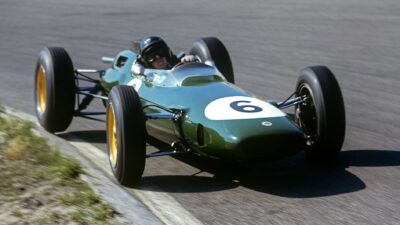
Lotus 25: potent racing weapon, and a grand prix game-changer
It’s a slight problem to choose a car I didn’t do because I’ve been associated with so many over the years, much more than most I suppose [Lola, Brabham, Gurney-Eagle, BRM, Shadow, Lotus, Arrows, Osella, FordJaguar, Toyota, Ferrari, Lister, TWR-Nissan]. I can’t think of any modern F1 cars I could get excited about — they’re all from the same mould. I have to go back a long way to find something interesting, and I’d pick the Lotus 25.
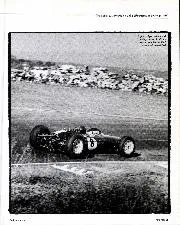
I was just starting at Lola when the 25 came out in 1962, though I’d been playing around with 750MC projects before that as an apprentice, and it was stunning — this super-sleek monococque, every aspect of it was perfect. Typical Chapman, minimum number of parts, some of them doing two or three jobs. Not only was it clever and light, with its inboard suspension and aluminium structure, but it was so good-looking. The proportions were fabulous — like a pencil, totally designed around the driver. Of course Jimmy Clark was a smallish man, so Chapman could go to town on making it compact. And the Climax V8 was a compact engine. It looked like a Formula Junior.
We all thought it was brilliant. Even though Eric [Broadley] was in his prime he scratched his head and said “Bloody hell, how are we going to beat that?” To get up to that level was going to be a monumental jump — and nobody did it. Its rivals only used to win by default; unless the engine blew up the 25 would win. Some parts used to fall off, but it made everything else look like a tank, and everyone just copied it. In those days everyone waited to see what Chapman was up to and then did their version of it. He was just light-years ahead.
25 was tightly packaged around Clark’s slim frame
Getty Images
I worked for him years later; had great admiration for him but he was a pain in the arse to work for, incredibly difficult. As chief engineer I was first in line after him and I took all the blows. One of those great experiences you don’t want to repeat… Chapman was so finicky it was untrue. His office was like that, and you never saw him ruffled or scruffy — he was Mr Perfection, and that’s why his cars were always like that. Even then, which was quite late, his original approach was still there; if you had any problems he would suggest something which made you say ‘why didn’t I think of that?’. Chapman’s route was pure design, the excitement of producing something different, whereas, say, Ron Tauranac’s approach was to build a production car which would make some money and win races. He didn’t care whether his car was considered superior as long as it won races, whereas in my book superior would mean design superiority, clever and original thinking.
“Chapman was our best designer by miles”
The late ’50s was the most exciting time when it was all happening — Chapman, Broadley, there were loads of them coming along. And with FJ there was a stunning array of cars. That gave Britain something the rest of the world didn’t have, and we’re still building on that. It wasn’t only Lotus — Eric Broadley’s early designs were incredibly original. Those little sports cars and FJs were pretty slick, and already had inboard springs with push-rods like they do now. That was Eric’s suspension, it wasn’t taken from anything else. And the sports cars — unusual layouts, asymetrical chassis. It was very exciting in those days — but as I was working there I’m not allowed to choose those for this story. Of course there’s nothing new in motor racing — it just takes someone to take a gamble, put it all together and make it right; and Chapman was a great one for that. Even monocoques weren’t new — the Fryclimax used one, an F2 car I used to see at Mallory in the late ’50s, with aluminium wishbones and rubber suspension. The driver sat up between the front wheels with a Climax engine behind him.
Chapman was our best designer by miles — no-one else has approached him for original thinking. Original thinking is incredibly rare; you’ll find very little genuine originality around. Most people do a variation of somebody else’s car, or they take all the good bits and put them together. I’ve looked at bits on cars and thought, that’s good, I’ll use that But! always try to add something original because without that you’re not going forward.
That’s why I like sports cars, for the variety: a designer can actually have a go. I like F1, though modern GP cars are ugly things; but the design is laid out for you; there’s so much money involved that if you deviate you’d get sacked. You can’t take risks with sponsorship.
However, in sports cars you can still build a front-engined car which will defeat the rear-engined cars, or make a turbo or a naturally aspirated car… It’s the only international format where you can do that, and it encourages people like Laurence Pearce with his Lister. I helped with that too; the front suspension is straight off my drawing board, which I did as a quick fill-in job after the Ferrari 333 project stopped and before I started back on the TWR-Nissan. And though it is front-engined, it doesn’t lack any downforce, it’s well balanced, and eventually it was running with the works McLarens. On a shoestring budget too.
My back-up selection would be not a car but an engine — the DFV. Keith Duckworth deserves so much credit. Mind you, he had a lot of help from Chapman over packaging, so everything was just where a chassis designer would want it. The DFV allowed anyone to buy an engine, bolt it onto a chassis and go out and win GPs. And that let the British racing car industry shoot ahead; people like Williams wouldn’t be anywhere without the DFV. Ferrari would have won everything. BRM might have done alright for a while, but would have fallen over themselves supplying engines… British GP racing just wouldn’t be as powerful as it is now without the Cosworth kit-cars.
Bravely ignoring his degree in industrial design after discovering night rallies in a Renault 8, GC joined Motor Sport by accident, in the Teesdale days around 1982 when Jenks and WB were office regulars and Mr Tee ruled with a rod of cardboard. He took part in some of the early historic rallies, winning one of the Pirelli Marathons, and regularly runs his Mk2 Jaguar in road events.






 Great Read