

 Great Read
Archive
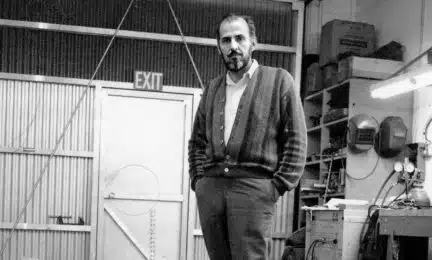
Don Nichols: Shadowman
I don’t think the idea ever was to make money. It was to make an art piece, an active art piece which was not only attractive but high performing, and…

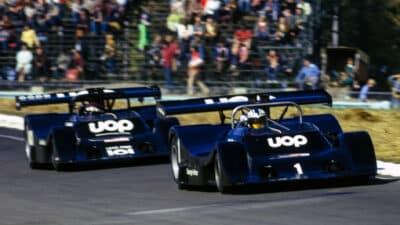
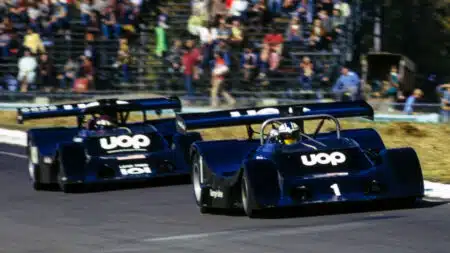
Follmer leads Oliver as they go full-throttle during Can-Am's '774 campaign
Getty Images
You can look at Can-Am 1974-style in two ways. The embers of a once-great series given a chance to glow one final time. Or proof that it takes only two can to make a race.
Jackie Oliver can view it in a third light: the zenith of his driving career. After falling out with John Wyer not long after that remarkable Le Mans win of 1969, he crossed the Atlantic to drive the all-new Peter Bryant-designed titanium Ti22 in the Laguna Seca Can-Am race. The following season, this combo occasionally threw down the gauntlet in front of the McLaren steamroller, and Jackie scored a handful of podium finishes.
Don Nichols decided the Bryant-Oliver combination was one he needed at AVS Shadow for 1971. The team’s first Can-Am car had flown the flag for innovation in ’70 — as encouraged by the series’ dearth of restrictions — but it had taken its toll on the sanity of all involved in the tiny-tyred, largely pointless project. Now, Bryant’s design, though far from conventional, was at least nearer normality than its predecessor. And yet still there was little to show for it at season’s end. It was the same story in 1972, even with an apparently worthy car. This time the underperfomance was the result of another let’s-run-before-we-can-walk approach: Shadow began testing a turbocharged version as well as racing the normally-aspirated car.
“From the racing point of view it was useless overkill,” recalls Oliver. “Big turbos on an 8-litre meant wheelspin in top gear, so it ended up slower than the normally-aspirated version.”

Shadow was the only serious Can-Am contender during the championship’s swansong
Getty Images
That didn’t stop Nichols pursuing the (twin!) turbo route to combat the similarly-boosted Porsche’s that had proved the class of ’72. Thus, although Tony Southgate’s credentials as Bryant’s replacement were first-rate, he was working with one hand behind his back when designing his first Can-Am Shadow, for 1973.
“The DN2 was originally supposed to use the turbocharged Chevy,” says Southgate, “and I told them we had nothing that could cope with its ridiculous horsepower — about 1250 — like transmissions, drivelines and so on. But we built this bloody massive car — and after all that, the engine didn’t work. So towards the end of the year we switched to the normally-aspirated engine and it chugged round and got a couple of results.”
There were some accusations at the end of the year that Shadow had been distracted by their first season in Formula 1, but this is unfair, as Southgate explains: “The F1 cars were made in Northampton and the grand prix campaign operated out of there, whereas the Can-Am cars and F5000 cars were built here and shipped out to Don’s raceshop in America for the development and engine installation. The facility out there was equal to what we had in Northampton, but they didn’t have the personnel, whereas I had John Gentry and Andy Smallman working for me. So although the F1 project was bigger, I think we had a very good, organised set-up. Our team of 30 had no problem coping with the demands, and the Can-Am cars had little to do with us once they were designed and built.”
Before the ’73 season was over, Nichols had started singing from the same drawing board as Southgate. For the next season, he declared, Shadow needed something small, light and non-turbo. And that’s exactly what emerged from Northampton.
“It was totally new,” says Southgate, “though it looked like a seven-eighths scale DN2. It ran on little 13-inch wheels and was based on the DN3 F1 car; look at the suspension components and the monocoque and it obviously came from the same office.”
The small-and-light cause was helped by considerable shrinking of the fuel tanks: Can-Am had introduced new ‘energy measures’ for 1974 which stipulated three mpg as the minimum efficiency of any competitor’s engine. Very worthy, for sure. The surely intentional side-effect, however, was that the dominant Porsche turbos had to run their boost at a level where their power outputs were on par with the big-block Chevys.
Porsche turned on their heel and left the Can-Am scene; McLaren and Lola weren’t tempted back — and so Shadow faced 74 with two cars and no works opposition. And, tragically, without Peter Revson. Having signed up to the squad’s Formula 1 and Can-Am campaigns, the dashing American was killed in an accident during pre-season F1 testing at Kyalami.

Follmer was champion in ’72, but found things more difficult two years later
Getty Images
Shadow’s Can-Am operation did, however, gain Mike Hillman, who’d worked with Southgate at Brabham. Hillman had chosen a new direction in life, moving away from design and into team management. He soon proved an enormous boon.
“Well, obviously, the DN4 was a tremendous car,” he states, “and the fact that it was constructed in only 90 days meant it was ready long before the Can-Am season started in June. So I was determined to grab this opportunity to make the car absolutely bulletproof, and to this end we spent a week at Riverside and put about 1800 miles on the car. Lee Muir, who was in charge of preparing the Chevy engine, had also done a superb job.”
With Revson gone, the second Shadow would be driven by 1972 Can-Am champ George Follmer, who had just finished a year as Oliver’s Shadow team-mate in F1. They weren’t buddies.
“He was new to F1 whereas I had done a fair few years,” remembers Oliver, “so I outqualified and outraced him. So in Can-Am, an arena where he had been champion and knew the circuits, he thought he’d turn the tables on this cheeky little Limey. But he didn’t. To be fair, we were pretty evenly matched, but I came out on top.”

From left: George Follmer, Jackie Oliver and UOP Shadow chief Don Nichols – the team-mates weren’t on best terms
Bernard Cahier/Getty Images
The first three rounds of the season were all Shadow 1-2s, all Oliver-Follmer. Did team orders come into play? Jackie says not: “If there had been any team orders, they would have favoured George, because Don Nichols wanted an American to win the title for our sponsors Universal Oil Products [UOP]. But nothing like that was imposed because Don expected George would beat me in Can-Am.”
Hillman says: “The only instruction was not to crash into each other. Their rivalry was good for the team; they pushed harder.”
Nichols himself, however, states that there were team orders: “Whoever took pole, it was his race to win. But every time George got pole, he’d encounter some problem that prevented him taking victory — a puncture at Mosport and a broken exhaust at Road Atlanta. Thereafter, Jackie always had a surplus of points, so there was no need to tell George to follow Jackie. Not that George remembers it that way!”
At Watkins Glen, he was just plain beaten by the Englishman, and Follmer’s disgruntlement gave circuit promoters an angle with which to plug their Can-Am round. What the series desperately needed, though, was not intra-team rivalry, but competition for the runaway Shadows. In Mid-Ohio, that’s what they got.
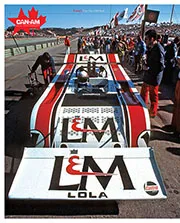
Brian Redman arrived with the Penske-run Porsche 917/30 which, in Mark Donohue’s hands, had thrashed all rivals in the ’73 season. The beautiful blue-and-yellow beast had had its claws clipped by the fuel restrictions, but that couldn’t stop Redman taking pole position for the preliminary race. Shadow’s brave gamble on dry tyres for that wet event left the black cars behind the Porsche on the grid for the feature race. But in the best battle of the year, it was Oliver who prevailed after some intense action: Redman half-spun; Follmer, because of increasingly wild driving, finally had to pit for repairs.

Oliver celebrates his Mosport win
Getty Images
“George’s car didn’t look right, so we signalled him into the pits for a check-over,” says Hillman. “But he thought we were bringing him in as some kind of team order because he was having too much fun out there, so he stopped the car, got out and stormed off.”
That Mid-Ohio victory secured the Can-Am title for Oliver, but Hillman remembers it for another reason: “That was a fantastic result because it validated Tony’s design. The Porsche was a hell of a car, Redman was a seriously good driver, so to have beaten the combination was something very special”.
Neither Shadow made it to the finish of the fifth round at Elkhart Lake, the victory falling to Scooter Patrick in a McLaren-Chevrolet M20. Then the sixth round, scheduled for Riverside, was cancelled. It was an ignominious end to the season. Three months later it got worse: Can-Am was declared dead.
That wasn’t quite the end of the DN4’s season. First there was a three-car race at Watkins Glen between Oliver, Follmer and Shadow’s F1 driver Jean-Pierre Jarier. Says Nichols: “Because Can-Am had been halted early, UOP still had some budget to spend. They really wanted the publicity, as lead-free fuel had been mandated worldwide. So they put up a $10,000 purse, and this 15-lap race was held just before the US Grand Prix.”
“It was just nonsense,” sneers Oliver. “I mean, the best driver of the three of us round the ‘Glen was Jarier but because he had never been in a Can-Am car before, he ended up the slowest. Then George disappeared in the race. But about four years later, I found out he had had a bigger engine, 540cu in instead of 495.”
True? Nichols thinks it might be: “We had a 540, and maybe Lee Muir’s friendship with George was stronger than with Jackie.”
Another Shadow exclusive was the F1 vs Can-Am race at Laguna Seca with James Hunt and Jarier in the single-seaters, Oliver and Follmer in the Can-Am’s. Jarier won. UOP loved it, but already the US arm of the team had switched its attention to F5000, where they scored some success with Oliver. However ,Jackie’s interest in driving hard had dissipated along with Can-Am. His mind was fixed firmly on sponsor-hunting for Shadow’s F1 team which was still run by Nichols, and which still had Southgate as its designer.
But if the principal players of the 1974 Can-Am season had plenty to occupy themselves, the series’ devotees had been left with a big-block-sized hole in their lives. And F5000 — even with fenders, a la ‘Can-Am’ from 1977 to ’86— never filled the void. Thunder road was now a cul-de-sac.
OLIVER’S CAN-AM
Career: 1969-74
Starts: 37
Wins: 4
Pole positions: 1
Fastest laps: 4
Series points: 206
 Great Read
So here it sits. McLaren M6A-1. Not McLaren’s first effort at building a sports car, nor even its first Can-Am car – that particular honour fell to the M1B -…
 Great Read
Colin Chapman’s stunning Lotus Type 66 Can-Am design lay rolled up in a draw for over 50 years – James Elson speaks to the people who brought it to life in 2023
He could hear voices from behind closed office doors. Loud ones. It was not a good sign. It’s early June 1971. The first Can-Am race, at Mosport, is less than…
Recently, Classic Team Lotus unearthed a fireproof case packed with 28 rolls of microfilm, which contained images of the Team Lotus original design drawings, a record initiated by Peter Warr…
McKee (1966-69) Bob McKee was an Indy 500 mechanic in 1961 when he performed one of the first-ever swaps of an American V8 into a British chassis, making a Cooper-Buick…
John Surtees is nine parts steely determination, one part cast-iron cussedness. By his own admission, he walked away from a probable Formula 1 world title in 1966 when he tired…
You can look at Can-Am 1974-style in two ways. The embers of a once-great series given a chance to glow one final time. Or proof that it takes only two…