MotoGP has a long habit of copying Formula 1 in Dorna’s efforts to jazz up the championship to attract more fans. Nothing wrong with that. But MotoGP riders aren’t circus performers, so one day there will come the straw that breaks the camel’s back.
Sprint races are a case in point. They more than double the weekend’s maximum risk and danger points from two (the end of qualifying and the start of the race) to five, for riders that go through Q1 (pre-qualifying, Q1, Q2 and the start of the sprint and the GP), and to four, for riders that go straight through Q2.
No wonder that 2023 – the inaugural sprint season – was the first year in world championship history that not one grand prix started with a full grid, due to increases in crashes and injuries.
At the same time riders are forced to do more and more promo work, with track time reduced accordingly. On Sunday at Misano the latest copy-and-paste feature from F1 was introduced. Before the start of each GP, when riders are trying to get themselves in the zone, visualising the start and first few laps, they must go to the front of the grid for the national anthem.
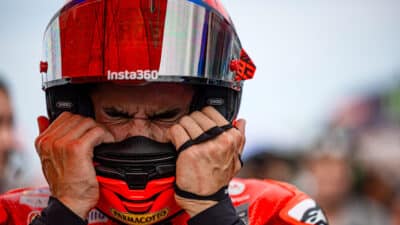
When I asked Marc Márquez about this after Friday practice, he answered, “Always they ask more and more and more [of us] and some day it will explode.”
Misano was significant in this process because it was the first race since Liberty Media completed its acquisition of Dorna that company management turned up to check out their new property.
There is little doubt Liberty will further jack up the razzmatazz in MotoGP, but they need to understand that this isn’t Formula 1. If they need convincing of this, all they need to know is that two Dorna/Liberty championship riders have died in the last few months, one of them a child.
Dorna’s Carlos Ezpeleta and Kelly Brittain (centre) with Liberty Media management at Misano
Oxley
Thus Liberty is playing with lives much more so than it does in F1. An F1 driver can crash into a guardrail at 120mph, his car catch fire and then walk away with minor burns. MotoGP riders are not afforded this luxury. Most of them are permanently hurt, carrying new and old injuries, because they crash all the time, because MotoGP’s performance-equalising technical regulations (also F1-inspired) force them to take more risks. That’s why today’s MotoGP riders crash almost twice as often as MotoGP riders of the late 1990s.
MotoGP riders are so concerned by this state of affairs that they often talk about hiring a riders’ representative to look after their interests, mainly from a safety point of view.
But they don’t need a riders’ rep, they need a lawyer. A riders’ rep would most likely be a former rider, who would stand little chance in a fight with MotoGP management and if he/she got into a big fight with Dorna, he/she would most likely never work in racing again, because Dorna basically own international motorcycle racing.
Marc Márquez is within touching distance of his seventh MotoGP crown but had his toughest race victory of 2025 at the San Marino GP, as KTM hit chain trouble and Yamaha’s V4 fell flat with Fabio Quartararo
By
Mat Oxley
A lawyer would listen to the riders and then get stuck in with Dorna, because that’s what lawyers do. They are the prosecution or the defence, so they live their lives in the middle of that fight. A lawyer would have the muscle a riders’ rep would never have and know exactly how to leverage the power of the riders to get what the riders want.
F1 drivers have had lawyers looking after their interests for decades.
MotoGP riders could comfortably fund a lawyer to follow the entire championship: £25,000 from each factory rider and £10,000 from each independent rider would give them a purse of £350,000.
Although Liberty now owns Dorna, it is Dorna that’s pushing through the current changes to take MotoGP in its new direction.
This includes transforming the Moto3 world championship into a one-make series, primarily to reduce costs. This move has been under discussion for the last couple of years and rumours at Misano suggested that Moto3 will soon switch to chassis made by Moto2 dominators Kalex, powered by Yamaha YZF-R7 twin-cylinder road-bike engines.
Moto3’s 250cc KTM and Honda singles are likely to be replaced by Kalex machines powered by 700cc Yamaha road-bike engines
Dorna
Apart from reducing costs, another concern has been the huge difference in machine dynamics between Moto3 and Moto2 bikes, which can make the graduation from the junior class to the intermediate class a real problem, even for very talented riders.
Current single-cylinder 250cc Moto3 bikes make around 60 horsepower, 12 less than a stock R7, so a race version might make around 80 horsepower, 60 less than a Triumph 765 Moto2 engine.
Dorna is also planning to segregate the MotoGP paddock from the Moto2 and Moto3 paddocks, to further focus attention on the big class, another concept borrowed from Formula 1.
As a racer, Mat is an Isle of Man TT winner and lap record holder. As a scribbler, he’s been at it since the late 1980s and has written acclaimed biographies of Valentino Rossi and Mick Doohan – plus he’s an award-winning commentator too.