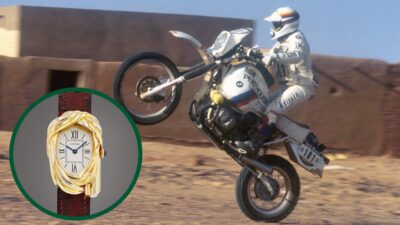
Gaston Rahier is the only racer ever to receive a Cartier Cheich watch for winning two consecutive Paris-Dakar rallies, very much against the odds. The unique timepiece is now up for auction, with a steep estimated price
1984 Paris-Dakar win was the first of two that earned Gaston Rahier the Cartier Cheich watch, inset
The Paris-Dakar is often billed as racing’s most gruelling event. Most don’t even finish the 8,000-mile route, let alone win. And the odds of two consecutive victories in the same category? Nigh-on impossible.
When the Cartier Challenge for just that feat was announced in 1983, its organisers could have been forgiven for thinking that nobody could ever succeed given the many perils between the Place du Trocadéro, in the shadow of the Eiffel Tower, and Senegal on the other side of the Sahara.
Devised by Paris-Dakar founder Thierry Sabine and Alain Dominique Perrin, president of the jewellery firm Cartier, the glittering prize was a “mythical” bespoke Cheich watch, crafted in three types of gold, which could only be obtained with victory in the challenge.
Rahier was the only winner of the bespoke Cartier Cheich watch
Sotheby’s
Enter Gaston Rahier. The winner of 29 motocross grands prix, his world championship career had been ended by a hand injury and the diminutive Belgian had turned his attention to riding his motorcycle in rally-raids.
At 5ft 1in, he was too short to put his feet on the ground when astride the bike, so Rahier had to dismount each time he stopped — which wasn’t often. Tearing through the Sahara in a swirl of sand on a BMW R80 GS, his first Paris-Dakar victory came in 1984.
A second consecutive victory wouldn’t come easy. Racing on a tougher route in 1985, Rahier was hit by a truck, was left without support when his team-mates retired, and dropped two hours when he got lost. But his determination and pace, combined with his rivals catching some of his bad luck, saw him race onto Dakar beach as the winner: the first and last racer ever to win the Cartier Challenge.
Following his death from cancer in 2005, Rahier’s family is auctioning his prize, the only Cartier Cheich watch in private hands. To be sold with Sotheby’s, the timepiece is engraved with the Paris-Dakar logo and comes with its original curved triangular presentation box, reminiscent of the sand dunes of the desert race.
Presentation box is inspired by the Saharan dunes on the original Paris-Dakar route
Sotheby’s
“As a true horological masterpiece, and for its association with the triumph and tragedy of the legendary Cartier Challenge, it has achieved near mythical status,” said Benoît Colson, Sotheby’s international watch specialist.
“Nothing quite like it would ever be made again, and its reemergence now from the family of the great champion to whom it was awarded, like a holy grail, is any serious watch collector’s dream.”
The main Dakar event might seem gruelling enough, but some are bravely taking on the Saudi stages in vintage machinery – some over 50 years old
The watch will be auctioned at September’s Luxury Edit sale in Paris, and carries an estimate of €200,000 to €400,000 (£170k-£340k). Only two others were made and both are owned by Cartier.
“There is no doubt that this Cheich watch, the only one awarded and the only one to come from private hands, is one of the most important Cartier wristwatches ever made,” said Colson.
Rahier won his first Belgian junior motocross championship aged 16, became world motocross champion three times, riding a 125cc Suzuki, and was awarded the National Trophy of Sporting Merit, Belgium’s highest sporting accolade.
After almost losing his hand in 1982 accident, the dogged Rahier, nicknamed the “little man with the giant reputation,” returned to racing and entered his first Paris-Dakar in 1983, retiring from the lead with a crankcase problem.
His triumph in 1984 came at the expense of Hubert Auriol who had won the Dakar motorcycle category twice and took eight stage victories in ’84. Rahier only won three stages, but finished first thanks to his consistent pace and no lack of determination.
Rahier celebrates victory in ’84
Getty Images
That extended to ditching most of the ten litres of water that riders were obliged to carry in case they got lost. Years ago, Rahier told Mat Oxley that he poured it away when out of sight of starting officials to save a few kilos.
He appeared to need every advantage in 1985 when a collision with a truck on the first stage put him 30th and well behind the leaders. Then his team-mates dropped out, and he lost a further two hours with a flat tyre.
Down and apparently out, Rahier launched a sensational comeback through some of the Dakar’s toughest-ever terrain. Chasing the frontrunning Gilles Picard (riding a Ligier-Cagiva alongside new team-mate Auriol), the Belgian rode with the leaders, despite lacking support from his absent team-mates.
In a Ténéré desert sandstorm where the rescue helicopter was in constant demand, Rahier pulled the deficit back to less than an hour and continued closing on Picard, who was being aided by the experienced Auriol. But time was running out and it looked as if it would all be in vain until mechanical issues hit both Picard and Auriol.
Once again, Rahier was the rider spraying the champagne on Dakar beach after what he described as “the toughest race of my life”.
Rahier in action on the 1984 Paris-Dakar
DPPI
Nobody else ever won the Cartier Challenge, which ended in 1986 after Dakar founder Sabine’s death in a helicopter crash. Rahier went on to race in the 1987 Le Mans 24 Hours and retired from racing in 2000.
His watch is currently on view at Sotheby’s Monaco gallery until July 17 and will then be exhibited in Paris until its auction.






 Great Read

