


Archive
What next for Lewis Hamilton?
Juan Pablo Montoya has always had an interesting take on things Formula 1 and he clearly follows it closely even though he left it mid-season 19 years ago. His views…


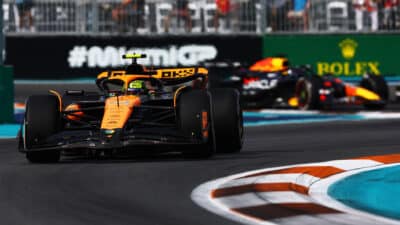
Will Red Bull re-enter the picture in Miami as it chases McLaren?
Getty Images
It’s Miami and we’re coming up to the one-year anniversary of the breakthrough win for Lando Norris and McLaren. The one which established that there was a new performance order in F1 after almost three years of runaway Verstappen/Red Bull success.
It happened very suddenly. Just a couple of weeks earlier in China as Verstappen had scored his fourth win from the first five races, having qualified on pole almost 0.5sec ahead of the best non-Red Bull, it didn’t look much like the end of anything. Just a continuation of ’23 and those 19 wins from 23 races.
Then just like that, McLaren turned up in Miami with the fastest car. It was no fluke either. For much of the rest of the season the papaya cars out-paced the field and the constructors’ title reflected that.

McLaren’s title challenge took off in Miami
Grand Prix Photo
But what had happened? Was some radical new technology introduced to the car in Miami? No. It had an extensive and very effective aero update kit on it (notably with more flexibility in the wings) and a new set of front brake ducts which did a great job of better controlling tyre temperatures. But nothing revolutionary. In fact, it remained a simpler design than the Red Bull but the more the Milton Keynes team tried to respond to McLaren’s speed with aero development, the more it imbalanced its car.
The Woking squad had perfected how it integrated its simulation tools – the tunnel and CFD – with track reality with a generation of car where that correlation was notoriously capricious. There was no mad rush to be forever bringing new development parts. Just a few focused update packages through the year, with nothing being made until the tunnel and CFD agreed. Red Bull, Ferrari and Mercedes all comfortably out-stripped McLaren in the number of upgrades they brought to their cars. If the tunnel was giving a green light but the CFD not, then it wouldn’t be made. If everything looked good in CFD but not the tunnel, no dice.
It was about making the two tools agree as closely as possible. Which took time. Because once into the gains made at the incredibly low ride heights these cars run, things can easily go exponential. It became clear that the previous expectation of tunnel and CFD agreeing was no longer always valid. It had become incredibly easy to head up the wrong development path and McLaren’s main rivals all did so as they added forever more new parts.

Verstappen has compensated for the Red Bull’s deficiencies over the past season
McLaren carefully introduced some innovation with the ’25 car, with a front suspension running even more anti-dive, allowing them the platform control these cars need to achieve consistent through-corner balance but without the extreme stiffness of others. That and an aero boost to the underfloor.
It’s taken Red Bull a few wrong turns with a difficult old wind tunnel to reverse out of its response to McLaren’s breakthrough at Miami last year. But might Miami this weekend again be the venue for a new performance order, as Red Bull brings an all-new floor based upon its new understanding? Or will it still be left relying on the genius of its driver to pull a rabbit out of the hat? This weekend might be a crucial inflexion point of the season.
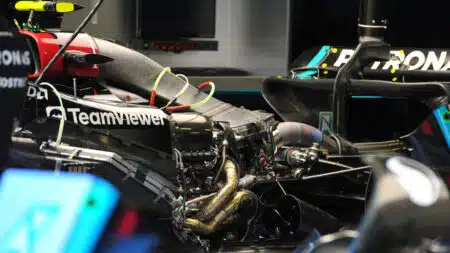
Mercedes is rumoured to have an engine innovation promising a significant advantage over other Formula 1 power units. It could mean rivals are allowed extra benefits to catch up, explains Mark Hughes

Adrian Newey a team boss? That really was not on anyone’s bingo card. Ever. But it came to pass on the eve of the Qatar Grand Prix as Aston Martin…
As the ground-effect era draws to a close, Mark Hughes uses qualifying data and technical insight to explain why the Formula 1 field has converged – and why the reasons go far beyond the rules alone

Mark Hughes weighs up an exceptional 2025 rookie class, dissecting four contrasting debut seasons to reveal who truly stood out the most

Mark Hughes revisits the race that gave McLaren team principal Andrea Stella a sleepless night ahead of this year’s Abu Dhabi Grand Prix: how victory in 2025 was forged from a Ferrari failure 15 years earlier

Mark Hughes explains how McLaren’s pre-planned lap-one swap and split-tyre strategy blunted Verstappen’s threat and laid the groundwork for Norris’s title-winning drive

As Abu Dhabi brings the three F1 title contenders together, their contrasting demeanours reveal as much about the pressure they carry as the points that separate them, says Mark Hughes

A lap-seven safety car forced a simple choice – and McLaren got it wrong, throwing away Piastri’s win and giving Verstappen a shot at the title, as Mark Hughes explains

McLaren ran its cars with a ride-height safety margin in Las Vegas, where Lando Norris and Oscar Piastri were disqualified for excessive plank wear. But, asks Mark Hughes, was that based on a more aggressive set-up to tackle Red Bull’s renewed threat?

McLaren’s disqualification from the Las Vegas Grand Prix led to speculation about a conspiracy to bring Max Verstappen back into the title fight. But there’s a more realistic explanation

F1’s 2025 championship leader said he had to go to real set-up extremes to make his car competitive in the final Las Vegas Grand Prix stint last year – could that be key to Lando Norris’s success in the race this season?

McLaren team principal Andrea Stella believes the current F1 generation is the most competitive in history and called on reporters to scrutinise the claim. Mark Hughes didn’t need any more encouragement