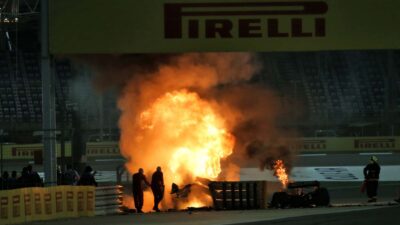
The findings of the FIA safety department’s investigation into Romain Grosjean’s fiery crash in the Bahrain GP were released on Friday, and they provide a chilling description of how it unfolded.
In addition to officially confirming a 67g impact at a speed of 192km/h (119mph) there is a lengthy list of conclusions that will help to make our sport safer in the future, and not just at the top level.
Those findings also take into account 18 other circuit racing accidents at all levels in 2020 that were investigated by the FIA, although it’s clear that many of the conclusions are a direct result of the Grosjean incident.
Among the outcomes is a design review into fuel bladders, focused on how they are installed and connected to further reduce the risk of spillage in a crash, after the report found that the fuel tank inspection hatch was dislodged and “the engine fuel supply connection was torn from the fuel tank ‘safety bladder’; both providing primary paths for the escape of fuel from the tank,” and fire to take hold.
“Commitment to reducing risks enabled Grosjean to survive an accident of this magnitude.”
There will be work into improving the heat resistance of gloves, following the burns that Grosjean suffered to his hands, and continued work on the extinguisher system for open cockpit cars.
Grosjean’s crash was caused when he crossed into the path of Daniil Kvyat, catching his right rear wheel on the Russian’s left front. The FIA announced a review of rear-view mirror regulations and will also investigate whether a parking sensor-type proximity warning and other electronic visibility aids — likely to include rear-view cameras — could be effective.
New types of barrier will also be assessed, and there will be more use of software that assesses which types of accidents are likely to happen at each point of a circuit,
The whole process is a reflection of the ongoing safety campaign that was kickstarted by the accidents during the 1994 season, and which has saved many lives in the years since.